Outdoor Rooms
Rainwater Harvesting Should Start With Where the Water Goes
Use rain barrels, cisterns, rain chains, downspout routing, and overflow planning to make roof water useful without creating foundation, mosquito, ice, or maintenance problems.

Most rainwater systems get bought in the wrong order — barrel first, plan afterward — followed by the slow discovery that the barrel has moved the puddle about four feet to the left.
A barrel under a downspout can genuinely cut potable-water use for some garden tasks. A larger cistern can carry a real irrigation strategy. A rain chain can make runoff visible and, honestly, lovely. What none of them do is manage drainage. They are storage, and storage is the middle of the system. Buy the middle before you have decided both ends and the water will discover the gap before you do.
The roof decides the system, so start there
Map which roof areas drain to which downspouts and where those downspouts currently discharge. Note roof materials, debris, tree cover, gutter condition, and whether runoff is already causing erosion or standing water near the foundation. This is an afternoon with a notebook, and it is the only part of the project that cannot be bought.
Do not disconnect a working drainage route until you know where both the captured water and the overflow will go. A route that currently works, even inelegantly, is doing a job. Interrupt it without a replacement and what you have installed is not a rainwater system. It is a leak with a lid.
Decide what the captured water is for
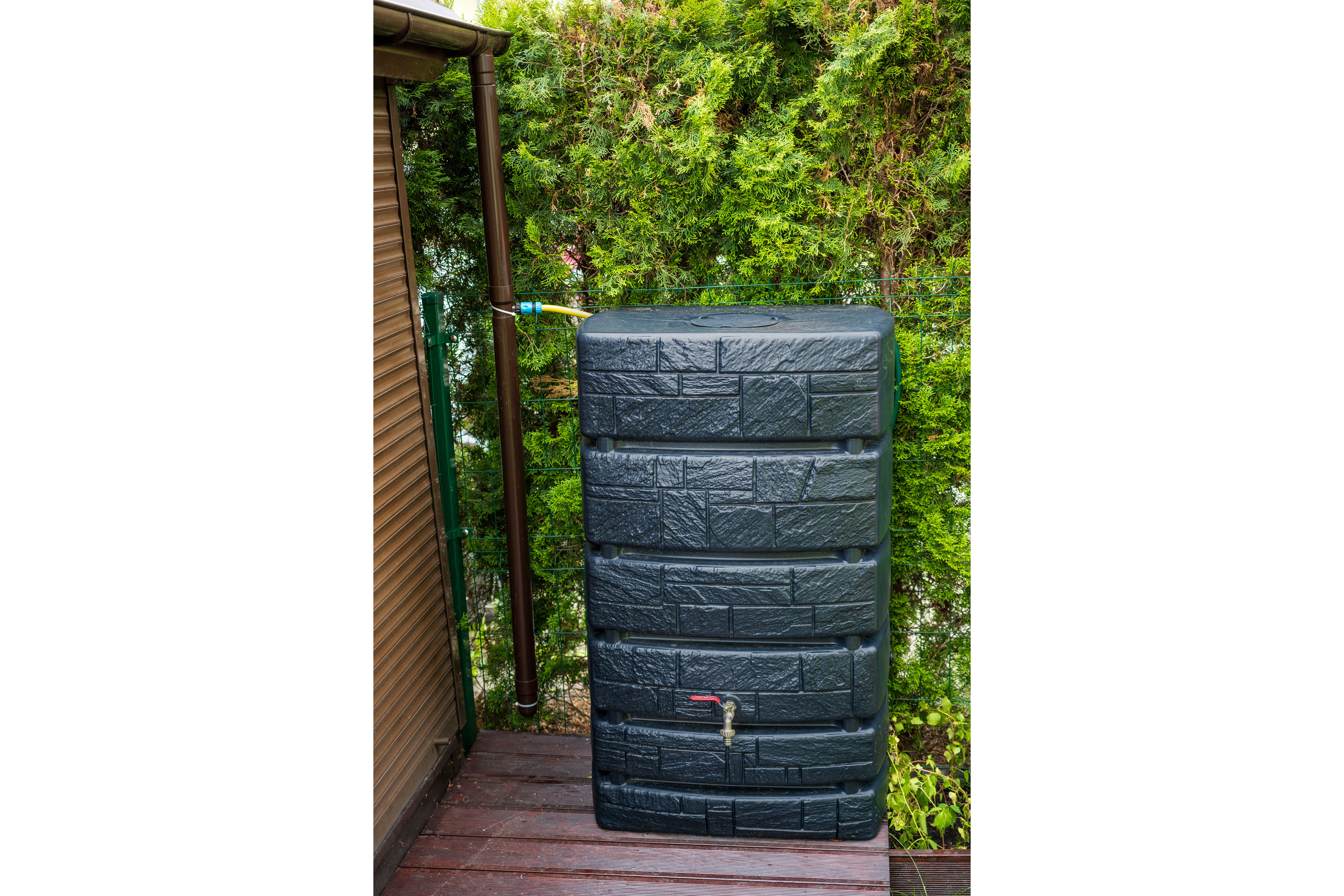
Landscape irrigation, container watering, and other nonpotable uses may be appropriate depending on local rules and system design. The intended use determines storage size, filtration, hose access, pump needs, and maintenance.
Do not assume captured roof water is suitable for drinking or edible-crop use without understanding roof materials, contaminants, treatment needs, and local guidance.
Design overflow before storage
Every storage container eventually fills. Overflow should move away from foundations and into a safe drainage or infiltration route rather than spilling beside the building.
Connect overflow to a rain garden, swale, approved drain route, or other suitable system where site conditions and local rules allow.
Use rain chains as visible drainage, not magic
A rain chain can slow and display water, but the water still needs a receiving basin, drain, gravel bed, rain garden, or other planned destination.
Wind, freeze-thaw conditions, roof volume, splash, and proximity to doors or walkways can affect whether a rain chain is a good choice.
A tank nobody can clean is a decorative object with a mosquito problem
The whole system lives or dies on whether a person will actually open it twice a year. That means screens, a sealed lid, filters reachable without dismantling anything, and inlets and outlets positioned for a human arm rather than for the product photograph. It also means the tank has to be stable when full, which is a different condition from stable when empty.
Skip that and you already know the result, because everyone who skips it gets the same one: a container of wet roof debris with branding on the side, breeding mosquitoes, attached to a house. It cost money. It is watering nothing.
Place storage where weight and access make sense
Water is heavy, and the number is the part people skip. Water runs about 8.3 pounds per gallon, so a full 55-gallon barrel is roughly 460 pounds standing on whatever you put beneath it. One paver pressed into soft ground is not a foundation. A 500-gallon cistern is over two tons and belongs on something designed for it. Size the support for the full condition, not the delivery-day condition, and keep valves, hose connections, filters, and cleanouts reachable.
Large cisterns, pumps, underground storage, structural platforms, or complex connections may require qualified design and installation.
Plan for freezing climates
Systems in cold regions may need seasonal draining, bypasses, protected piping, or other winterization strategies to avoid freeze damage.
Follow manufacturer and local guidance rather than assuming a summer installation can remain unchanged all year.
Gravity, pumps, and the hedge that eats the spigot
Elevated storage gives you a little pressure, and a little pressure fills a watering can perfectly well. It will not run most drip emitters, most sprinklers, or a long hose to the far bed. Match the delivery method to the pressure you actually have. A pump solves the pressure and adds power, maintenance, controls, and one more thing that can fail in the hottest week of the year — a fair trade if you need it, a silly one if the entire job is filling a can.
Then there is screening, which is where good intentions do the damage. A barrel or cistern can be planted around, folded into a side-yard utility zone, repeated in the material palette, or simply left visible as honest infrastructure, which is usually what I would do. What it cannot be is hidden behind a hedge that is charming at planting and impenetrable in three years. Screen the tank. Do not bury the spigot, the filter, or the cleanout.
Know the legal context
Rules governing rainwater collection, plumbing connections, backflow protection, mosquito control, and storage vary by state, municipality, HOA, and intended use — and not always in the direction you would assume. Colorado caps most single-family residential rooftop collection at two barrels and 110 gallons combined, outdoor use only, lids required. Other states hand out rebates for the same behavior. A national article, this one included, cannot tell you which situation you are in.
Check current local requirements before installing permanent or large-capacity systems.
Track whether the system is worth maintaining
Notice how often storage fills, how quickly water is used, which garden areas receive it, and whether overflow occurs regularly. A system can be resized or simplified based on real performance.
The goal is useful capture that fits the property’s rainfall pattern and irrigation demand. Maximum storage just buys a bigger tank to half-fill.
Four questions, answered before anything is delivered
- Where does the overflow go — on the ground, in the rain, with the tank already full?
- What is the water for, and is that use permitted where you live?
- Can one person clean the whole thing in twenty minutes without tools?
- What is holding up the full weight, and was it built for that or was it simply already there?
See A Rain Garden Should Solve Water Before It Tries to Look Natural and Outside.
If one of those has no answer yet, leave the downspout alone for another season. A plain working drain is not interesting, but it is a system that functions, which is more than an unplanned tank will be by August.
Same problem, elsewhere in the house
Room notes
Keep the room on the record.
One useful note at a time: what to test, what to ignore, and what changed when the room got another vote.