Outdoor Rooms
The Shed, Hose, and Storage Problem: Make Outdoor Utility Behave
Turn a neglected shed into useful garden architecture through repair, clear zones, safe storage, task lighting, weather control, and one restrained visual gesture.
On this page
9
Time the put-away. Not the gardening, not the dinner, not whatever game the children were playing — the part afterward, where everything goes back. If that number runs much past five minutes, the garden will get used less and less, and nobody in the household will be able to say precisely why.
Outdoor utility is the unglamorous half of garden design, which is exactly why it quietly wrecks the rest of the plan. Hose, tools, cushions, bins, soil, watering gear, sports equipment, seasonal objects: every one of them needs access, weather protection, and a reset simple enough to survive being done in the dark after work. The reset is the specification. Everything else here is a consequence of it.
Sort by activity, not by empty shelf
Separate gardening from watering from dining from play from maintenance from off-season, then put each group near the activity it serves, at the height its frequency deserves. Daily and weekly things take the easy reach. Holiday lights and the once-a-year equipment go high, deep, or both.
Hardly anyone does this, because sheds get loaded by whichever shelf happened to be empty on the day the object arrived. That is not storage, it is sedimentation, and it is why the trowel used forty times a year lives behind a bag of pea gravel bought for a project that never happened. A working shed is one where the location of every object is predictable by someone who was not there when it was put away. Beauty is a bonus.
Give long tools a stable home
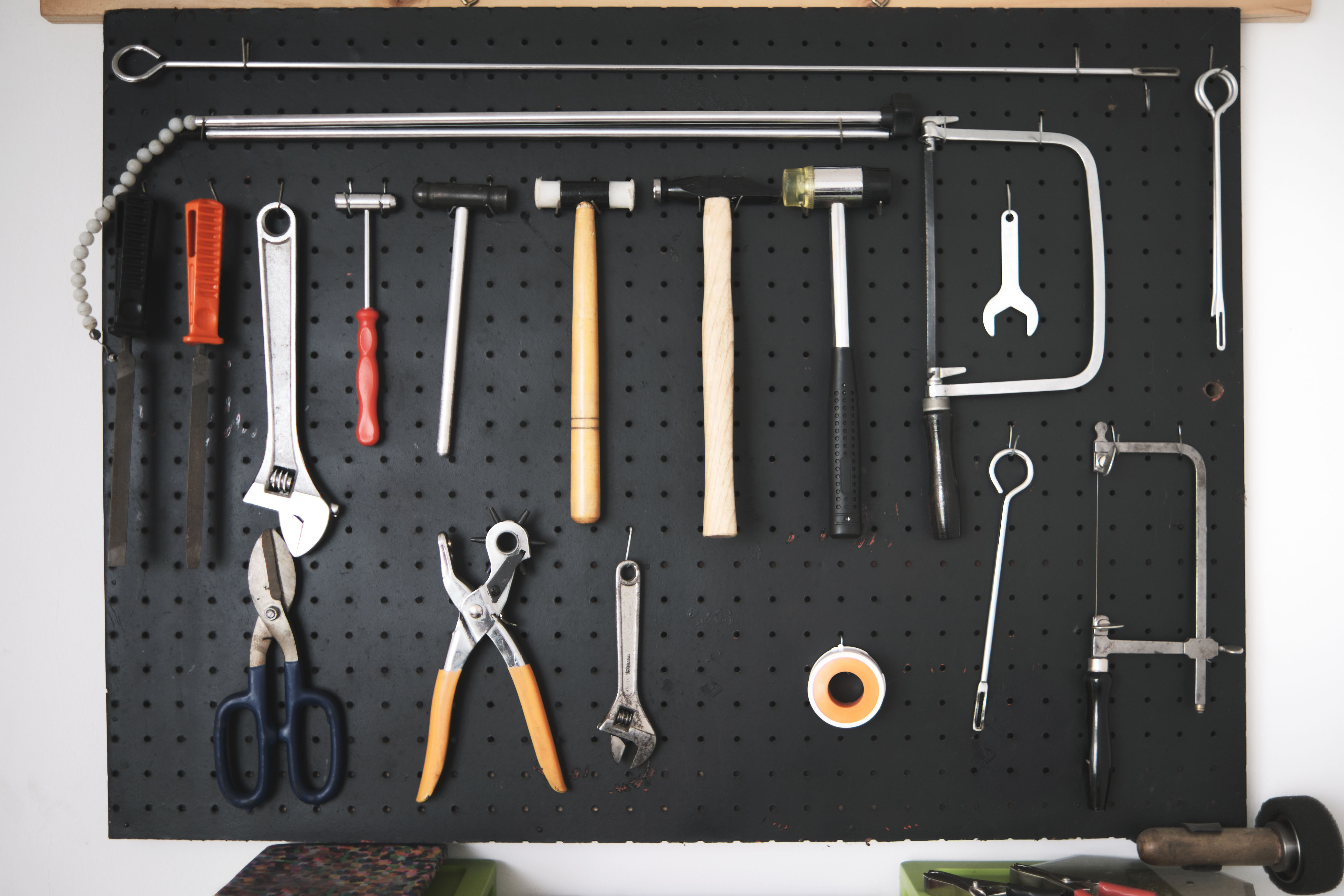
Rakes, shovels, brooms and poles leaned loosely in a corner are a genuine hazard rather than a tidiness complaint. One long handle slides and takes its neighbors with it, and the business end of each is a blade or a set of tines.
Use stable racks, hooks, or other storage suitable for the weight and structure. Keep sharp or hazardous tools appropriately secured, especially where children are present.
The working test is whether one tool can leave without the whole arrangement coming down. If getting the spade out means catching the rake with your other hand, the storage has already failed, and it will fail again at the exact moment both your hands are full.
The hose will tell you where the design is wrong
A hose left lying across the path is not laziness. It is evidence. The distance between where the water gets used and where the hose is supposed to live exceeds the household’s patience, and the hose records that fact daily, in the middle of the walkway, for anyone willing to read it.
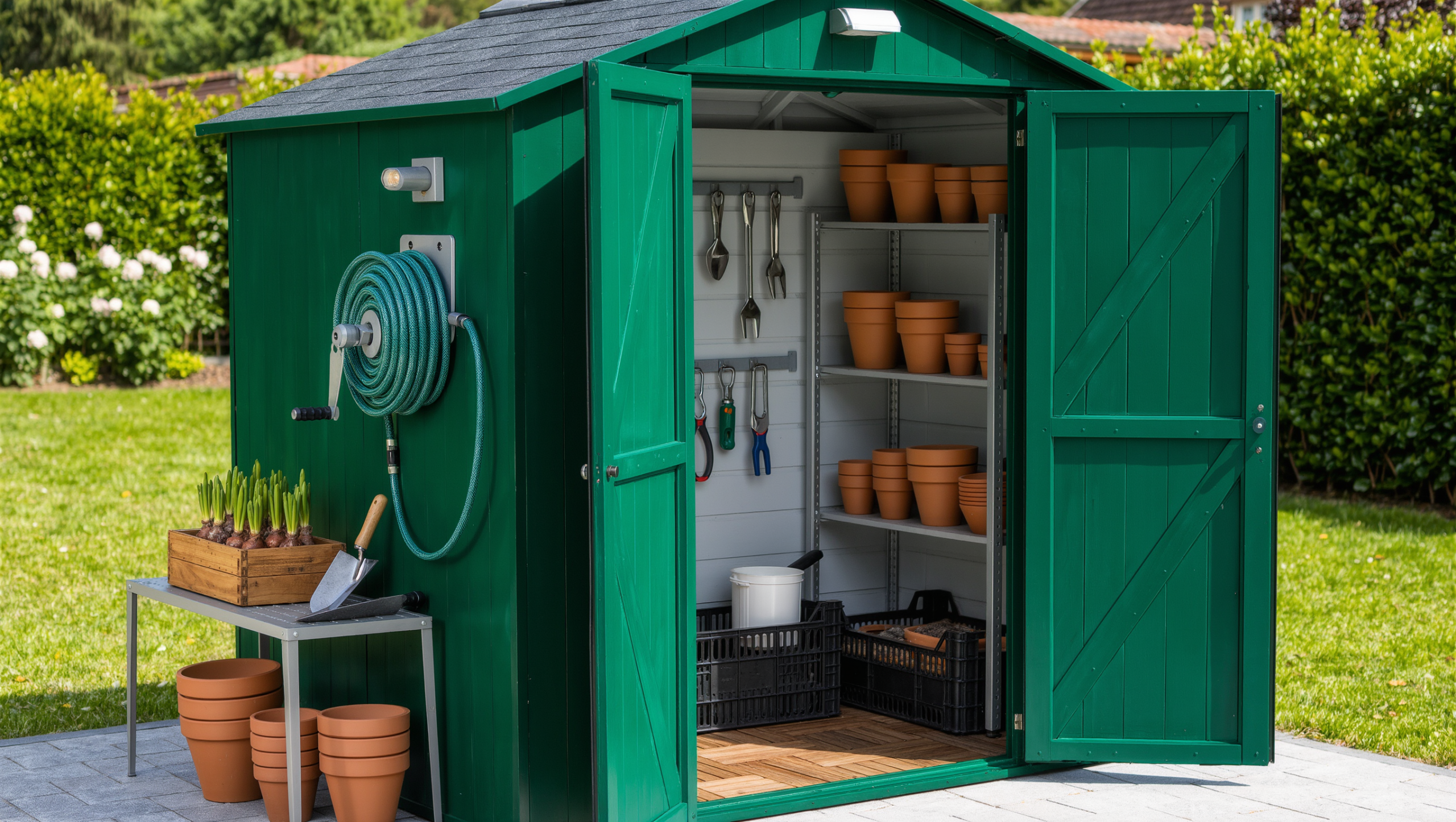
Pick a reel, hanger, box or other system that genuinely suits the hose length, the connection, the climate and how often it is used, and site it where winding and unwinding do not block the main route. A handsome pot that needs two hands and a crouch will lose to the ground within a couple of weeks.
Be honest about the priority, too. Hiding the hose matters far less than making it easy to put away. A beautifully concealed system nobody uses is worse than a plain reel by the tap, because the plain reel is empty.
Wet things stored as though they were dry
Cushions, hoses, tools, watering gear and garden materials all carry moisture, and the container has to suit its contents. Seal a damp textile into a closed box and nothing has been tidied — something has been started. Dry or ventilate as required by the material and product guidance, and choose storage with the ventilation the contents actually need.
Cushions are where this collides with the reset. If they travel the entire length of the house every time the weather turns, the outdoor room is too labour-intensive to be used casually, and it will end up used three times a summer by people who genuinely believed they would use it constantly. A weather-appropriate box, bench, cabinet or covered zone near the furniture shortens that trip enormously.
Near does not mean careless. The storage still has to respect drainage, ventilation, pest conditions and the manufacturer’s care guidance. A deck box that holds water is a planter with the wrong contents.
Walls first, floor last, aisle always
Vertical racks, shallow shelves, hooks and door storage keep the center of the shed clear, and the center of the shed is the thing you are really storing. Heavy items belong where the structure can carry them and where they can be lifted down safely; do not overload a door or hang an improvised system off whatever looked sturdy at the time. Then leave the aisle alone. A shed packed to capacity does not contain more, it contains less, because nothing can be retrieved without first unloading four unrelated categories. Maximum capacity and usable storage are different measurements.
If the household pots plants with any regularity, give that its own durable surface near soil, tools, water and somewhere for the waste. It contains the mess, which is the obvious benefit, and it protects the other surfaces, which is the real one. The outdoor dining table becomes the permanent potting station in a striking number of gardens, and it is a poor trade: you gain a bench and lose a table, and the loss announces itself on the first warm evening somebody wants to eat outside.
One shed is not one category
Soil bags, muddy tools, chemicals, cushions, table linens and serving pieces should not share storage casually. The temptation is to treat “outdoor stuff” as a single problem with a single building as the answer. It is not one problem, and the building is not the answer.
Keep garden chemicals, fuels, or hazardous materials stored according to product requirements and away from inappropriate heat, food, children, and pets.
That constraint is not negotiable, and it outranks the wish to make one structure hold everything. If the shed cannot keep fuel properly separated from the cushions, the cushions live somewhere else. That is the design.
Two routes: the glasses come in, the bins go out
Outdoor dishes, glassware, linens and serving pieces need a simple way back to clean interior storage. A tray, a basket, a small service cart — anything that turns six trips into two. Without one, the terrace becomes the place where last night’s glasses wait for somebody else to notice them, and that somebody is reliably the same person every time.
The other route runs the opposite way. Rubbish and recycling have to reach the street or the service area every week, in the dark, in the rain, carrying something heavy. Keep that path clear and do not build a permanent dining or lounge arrangement across it. Screening and planting can soften the view without turning the weekly trip into an obstacle course. A large planter sited for the photograph, directly in the bin path, gets shoved aside within a month and stays slightly askew for the rest of its life.
Charm comes second, and it does come
Once the utility genuinely works, the shed can stop being a tolerated object at the boundary. Paint, decent hardware, planting, a light, a door with some weight in it. A small outbuilding is one of the few places in a garden where a strong color decision costs almost nothing and changes the entire view, and I would go darker than feels sensible. A shed painted to disappear generally just looks apologetic.
Stop short of decorating it into uselessness. Anything that obstructs access, blocks ventilation or makes repairs harder is not charm, it is a future problem in a nicer color. The same restraint governs containers: outdoor storage degenerates into a heap of mismatched plastic boxes exactly as fast as indoor storage degenerates into baskets. Fewer, larger, genuinely weather-resistant ones, grouped by category, labeled wherever more than one person has to find things. The system should be legible to someone who did not design it — which, on some Saturday when you are not home, it will have to be.
Leave room for winter before winter arrives
Some equipment comes indoors, some stays out, and some needs protecting from freezing, moisture or months of direct sun. Decide that shift while the shed is still half empty, because the objects joining the system in October are real and they will need somewhere to go. A shed filled to the walls in July is a shed with a problem scheduled for autumn.
Then twice a year, open everything and look hard at what the system is actually protecting. Damaged fabrics, dead batteries, mystery chemicals, pest evidence, and objects nobody has touched in two seasons do not deserve permanent rent simply because a cabinet door can still close.
The hose usually deserves its own answer. Give the hose and its water infrastructure a proper home, or make the irrigation disappear into the planting, and the most awkward object leaves the shed argument altogether.
Same problem, elsewhere in the house
Room notes
Keep the room on the record.
One useful note at a time: what to test, what to ignore, and what changed when the room got another vote.