Function and Flow
Your Smart Backyard Should Not Need a Help Desk
Smart outdoor technology should remove friction from lighting, irrigation, power, audio, and comfort—not turn the backyard into another support queue.

I manage technical support for a living. I have absolutely no interest in opening a ticket because the patio lights forgot the Wi-Fi.
Outdoor technology is getting more capable: connected lighting, irrigation controllers, grills, speakers, cameras, heaters, shades, pool equipment, pumps, and entertainment systems. Some of it is genuinely useful. Some of it is a perfectly ordinary switch wearing a login screen.
I am not anti-tech. That would be a very strange position for me to take. I am anti-friction pretending to be innovation.
The smartest outdoor room is the one where the technology quietly handles the annoying part and then gets out of the way.
Automate the thing you are tired of remembering
Lights coming on at the right time? Useful. Irrigation following a sensible schedule and, where supported, responding to relevant weather information? Useful. A heater available without crawling behind furniture? Useful. A pump or fountain running when it should and not when nobody is there to hear it? Also useful.
The test is embarrassingly simple: did the technology remove a recurring task, reduce waste, improve access, or make the room easier to use?
If no, I am already suspicious.
If the automation itself needs constant babysitting, updates, account recovery, reconnecting, and somebody in the family saying, “Which app is this one again?” congratulations. You have hired yourself as unpaid backyard IT.
Every important system gets a manual escape hatch
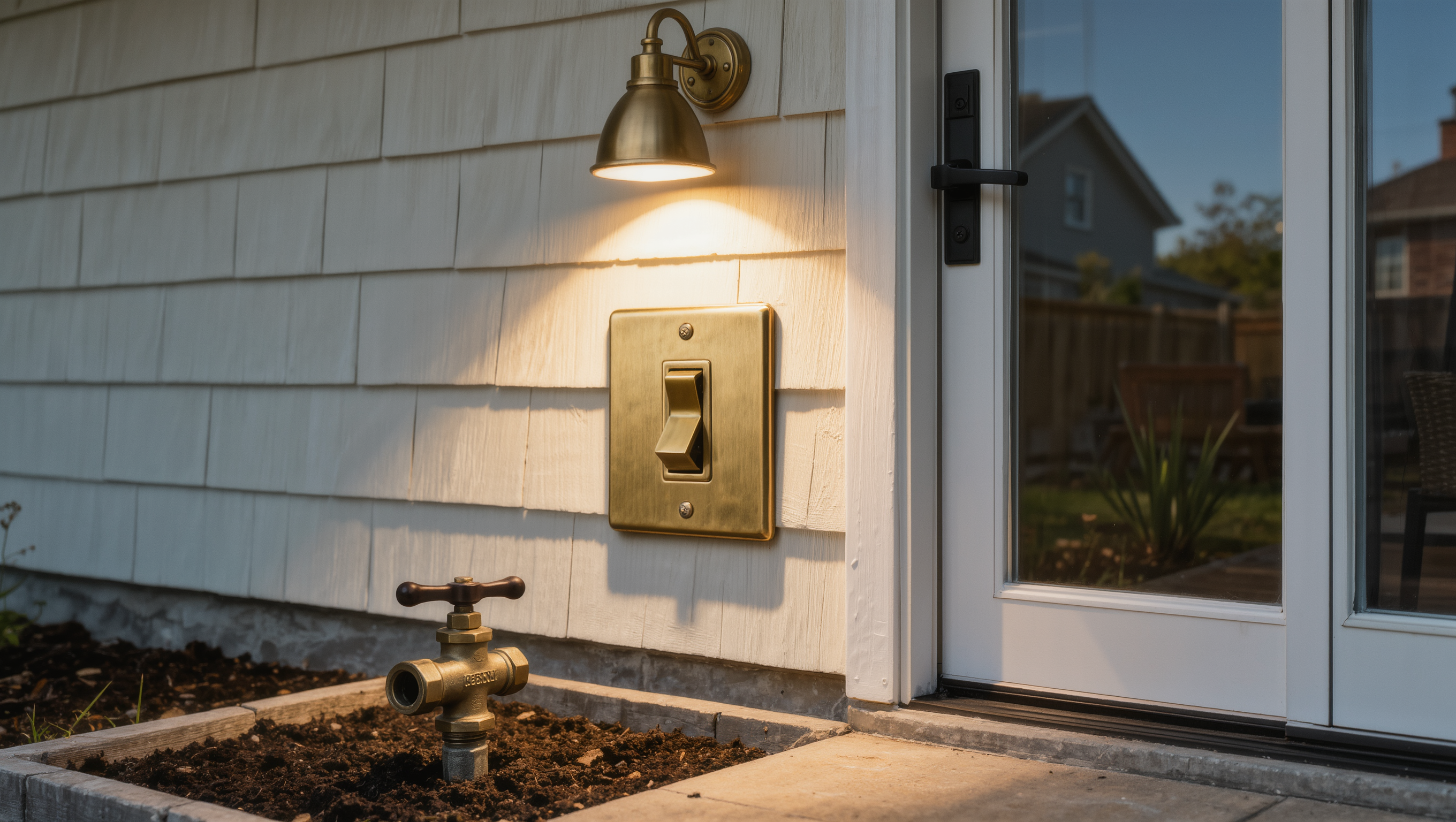
This is non-negotiable for me.
A wall switch. A physical button. A manual valve. A local control. Something that still works when the phone is dead, the app updates badly, the cloud service has feelings, or the internet decides it is taking the evening off.
Outside, this matters because technology can control visibility, heat, water, access, and equipment that has real consequences if it does not behave.
The patio should not become unusable because an account logged out.
I do not care how elegant the app is. If I cannot turn on a light without finding my phone in the dark, the system has become a parody of itself.
Power planning is less exciting than the gadget and far more important
Outdoor rooms accumulate devices at an alarming rate. Portable lamps. Speakers. Grills. Projectors. Fans. Heaters. Televisions. Pumps. Tools. Chargers. Holiday lighting that somehow becomes permanent lighting.
Before the products arrive, figure out where power actually belongs. Outdoor-rated outlets, protected connections, cable routes, charging locations, transformer access, and permanent electrical work should be part of the plan instead of an afterthought involving three extension cords and a prayer.
Use equipment rated for the exposure, and use qualified electrical help where permanent installation is involved. Safety is not where the personality needs to perform.
One beautiful outlet in the wrong location is still an outlet in the wrong location.
Lighting is where smart control can be genuinely excellent
Outdoor rooms change dramatically through one evening. Arrival is not dinner. Dinner is not late conversation. Security lighting is definitely not atmosphere unless your preferred atmosphere is municipal parking lot.
Smart scenes make sense here because the behavior actually changes.
Arrival can make the route readable. Dinner can bring the table and faces forward. Late evening can drop the room into lower, warmer pools of light while paths remain legible. A secure mode can do what it needs to do when nobody is using the space.
I would much rather have four useful scenes than individually name fifteen bulbs and experience a small identity crisis every time one gets replaced.
Irrigation cannot app its way out of a bad landscape plan
A smart controller may improve scheduling. It cannot fix incompatible plants on one zone, clogged emitters, overspray, bad pressure, compacted soil, broken heads, or a slope sending half the water somewhere else.
Technology belongs on top of competent design. It is not a substitute for it.
Walk the yard. Look at the plants. Notice dry spots, leaks, pooling, spray on pavement, and seasonal changes. The dashboard does not outrank the actual dirt.
This is one of my general rules with technology: if the physical system underneath it is bad, the app usually gives you a more attractive way to observe the bad system.
Outdoor audio should know the property line exists
Sound travels. The volume that feels perfectly reasonable from a deep chair can become surprisingly enthusiastic ten yards away.
Use localized sound at lower volume instead of making one speaker responsible for the entire yard. Think about neighboring windows, sleeping rooms, quiet hours, and the fact that birds have already been doing atmospheric audio for free.
I want music where the people are, not a soundtrack for everyone within range.
And yes, I have questions about the outdoor television
I am not anti-TV. I am anti-every-room-becoming-the-same room.
If your family actually watches sports outside, hosts movie nights, games, or uses a screen as part of how the space works, design for it properly: glare, shade, viewing angle, weather rating, cable management, sound, power, and secure storage where needed.
If the television is there because an outdoor kitchen apparently now needs a media package to qualify as complete, I give you permission to leave one wall innocent.
Not every surface needs content. Sometimes the view is the content.
Five apps do not make a smart backyard
Before you add another connected device, check compatibility, account requirements, local controls, software support, replacement availability, and whether it can live inside a platform you already use.
Fewer interfaces. Fewer accounts. Fewer obscure passwords somebody created on a Saturday three years ago and never wrote down.
I do not want a folder on my phone called Backyard Operations. I already have a job.
The best technology disappears into the evening
You notice that the path is lit. The plants got watered. The music is where you are. The heater is available. The shade moved when it needed to. Nobody discussed firmware.
That is smart enough.
Technology should make the outdoor room easier to live in, not more impressive to explain. If a manual switch does the job beautifully, use the switch. If automation removes a real recurring annoyance, automate it. If the gadget exists mostly so the backyard can claim another feature, I would rather spend the money on a chair I actually want to sit in.
There is one more number nobody prints on the box, which is how long the company intends to keep the servers running. A switch on a wall works in 2040. A light that needs an account works until somebody in a meeting decides the account is no longer commercially interesting, and after that it is a light that does not turn on. You do not have to be paranoid to see it coming. It is the ordinary end of a product lifecycle, arriving in your garden.
Source note: Houzz 2026 outdoor trends press release.
Same problem, elsewhere in the house
Room notes
Keep the room on the record.
One useful note at a time: what to test, what to ignore, and what changed when the room got another vote.