Outdoor Rooms
Give the Patio a Reason to Keep You There
An outdoor room begins with a clear activity, a readable boundary, and conditions that let people remain after the novelty of being outside wears off.
On this page
25
A patio can contain a sofa, a rug, three lanterns, and absolutely no reason for anyone to stay.
The furniture is attractive. The photographs promise effortless drinks at golden hour. And the space still empties after ten minutes, because the sun is in the wrong place, the seats face nothing in particular, the only table is decorative, the trip from the kitchen is a nuisance, or the evening air turns the whole arrangement into a windswept waiting room.
What was bought for the patio decides very little. What decides it is what the space makes possible, how long that possibility stays comfortable, and whether ordinary use — not the photographed use — supports the idea.
How long anybody stays
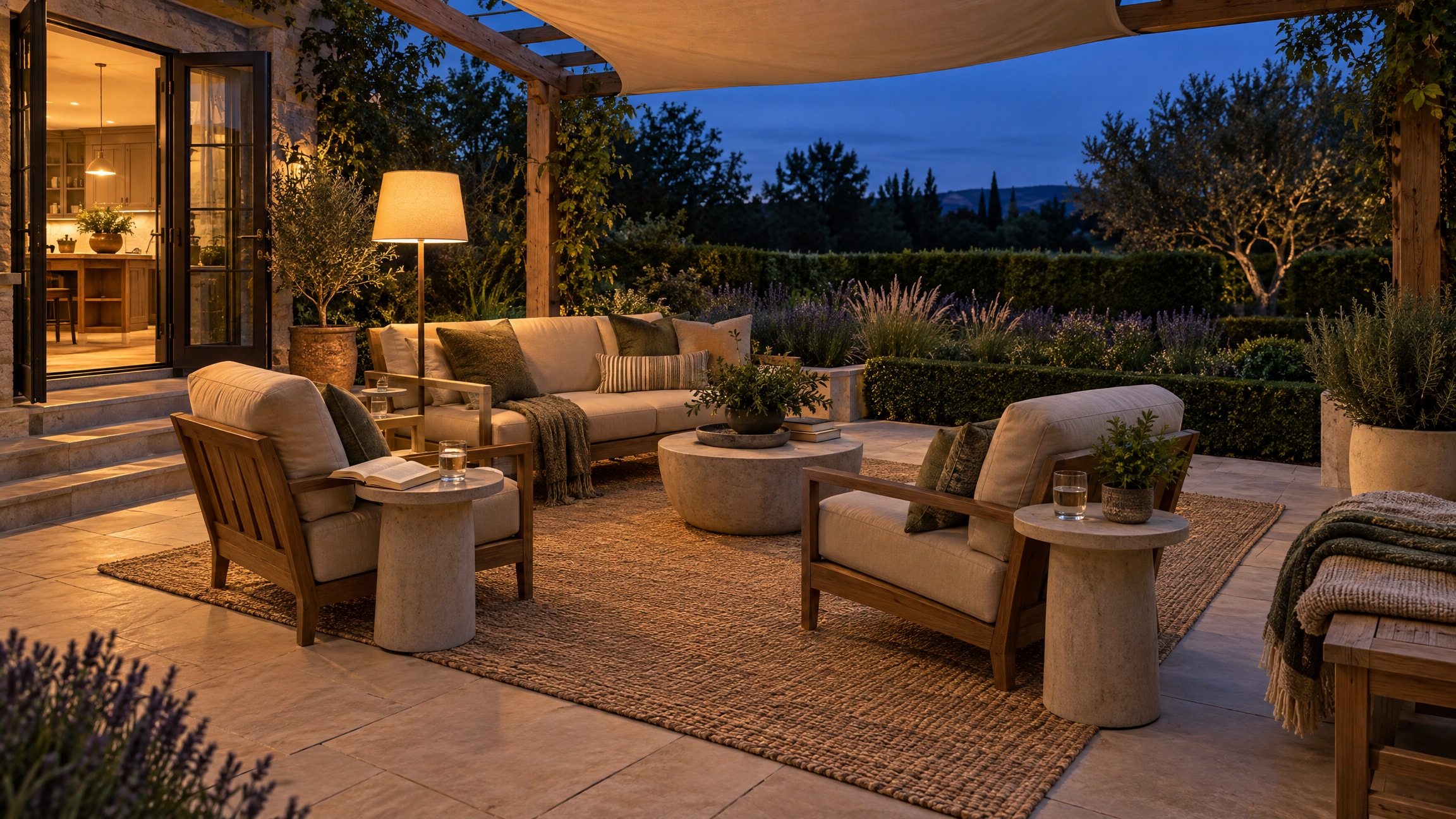
Outdoor rooms are measured in duration. Ten minutes with a coffee is a landing. Two hours with a book, a lamp, and somewhere to put the glass down is a room. The difference between those two is almost never the furniture budget.
Name the activity before arranging the furniture
Outdoor living is not a brief. It is a phrase from a catalog. A place for morning coffee wants almost nothing that a room for six-person dinners wants, and neither of them resembles what reading alone, or children on the ground, or talking until midnight actually requires.
Name one activity and the hour it happens. Then write down what that hour genuinely demands:
- a comfortable seated posture for the expected duration
- a surface within natural reach
- shade, warmth, or wind protection at the relevant hour
- a clear path from the house or garden
- enough privacy for the activity
- light that supports faces, food, movement, or reading after dark
- a believable reset when weather changes
One activity done convincingly beats a large arrangement gesturing at every possible life. The second kind photographs better and empties faster.
Different verbs produce entirely different rooms
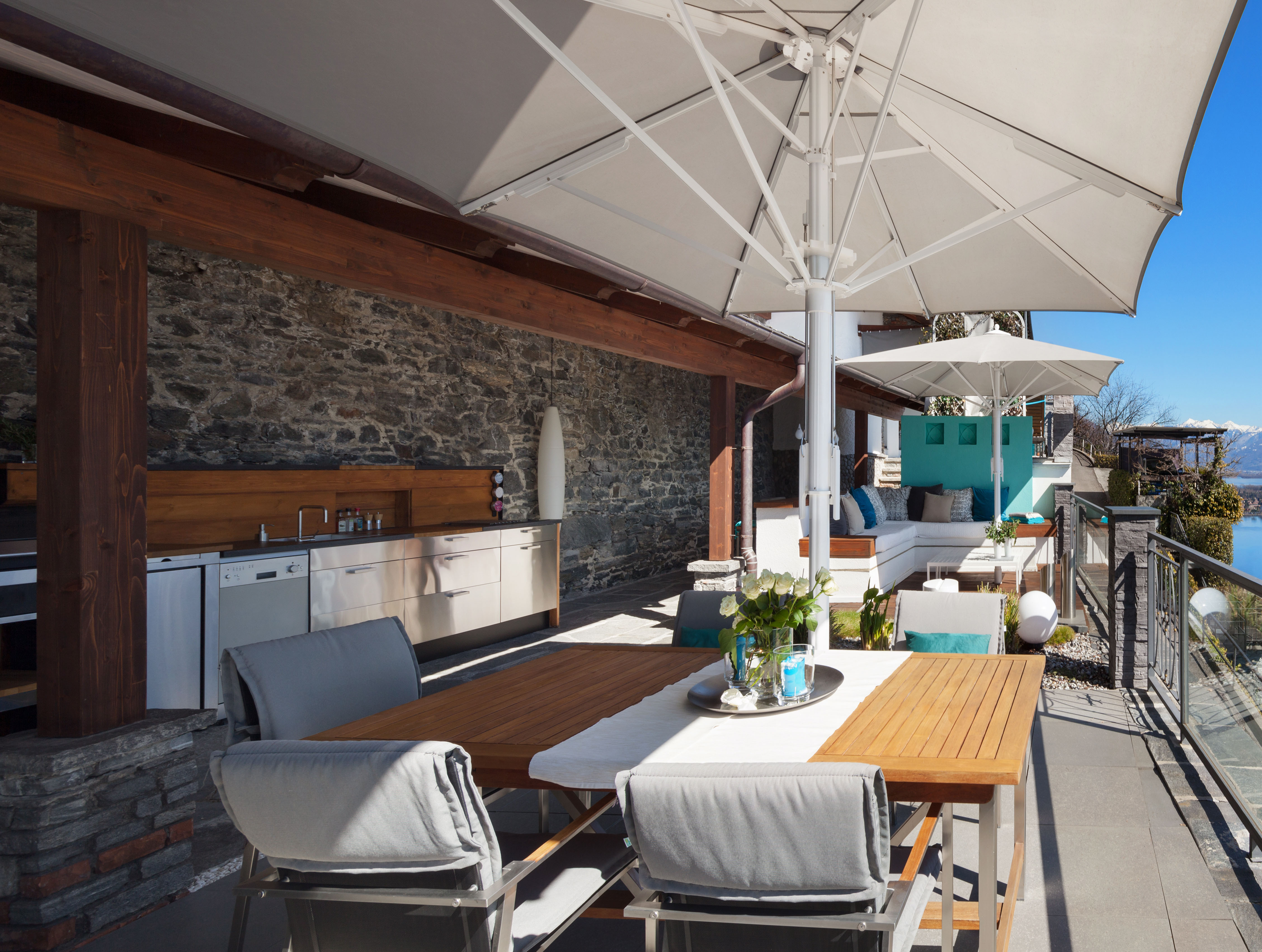
The same twelve-foot patio has several plausible futures. It cannot hold all of them at once, and trying is what produces a room that does nothing particularly well. Decide which life gets first claim on the footprint. The others can negotiate afterward.
The morning room
This room needs early shade or warmth, a dry seat, a small reachable surface, and a direct route from the kitchen. It may be intimate, lightly furnished, and oriented toward the first useful view rather than the broadest one.
The supper room
This room needs a stable table, chairs that remain comfortable through a full meal, believable food service, light over the eating surface, and enough circulation that one late arrival does not require the entire table to stand.
The after-dark room
This room depends on face light, warmth, low glare, protected conversation, and a clear return path. Its daytime appearance matters less than whether it becomes more compelling when the sky goes dark.
The making or gardening room
This room needs a durable work surface, water or tool access, storage, easy cleanup, and permission to look active. A decorative lounge arrangement would only interrupt the job.
With the governing verb settled, let the others in on purpose. Morning coffee and evening drinks share a room happily, because both want close seating and a small surface within reach. A full dining setup and a floor for children do not. Those two need separate modes, pieces that move, and somebody’s honest answer to how the room gets switched back.
Give the space a floor, an edge, and something overhead
An outdoor room almost never arrives with four walls and a ceiling. It gets assembled out of partial signals, and the body reads them anyway.
Ground
A rug, paving field, gravel rectangle, deck, or change in material establishes where the room begins and where furniture belongs.
Edge
Planting, screens, walls, curtains, level changes, and aligned furniture create enclosure, privacy, and orientation.
Overhead
A tree canopy, pergola, umbrella, awning, roof, or even a deliberate field of light lowers the perceived ceiling and makes the space feel held.
Center
A table, fire feature, view, planting composition, or conversation circle gives the room a point of gravity.
Those four have to agree with each other, and not one of them has to be permanent. A loose collection of objects turns into a room at the moment somebody walking up can tell where to come in, where to stop, and what the place is for.
Comfort is a system, not a cushion category
Outdoor discomfort almost never has a single cause. A deep, expensive sofa can fail because nobody’s feet reach anything, the side table is a lean away, the sun finds one shoulder at six, the insects have discovered the only lamp, and the walk back to the kitchen is annoying enough that nobody goes to fetch what is missing. Five small failures, one abandoned patio.
Posture
Match seat depth, back support, arm support, and table height to the duration and activity. A perch for ten minutes is not a chair for dinner.
Reach
Every occupied position should have a believable place for a drink, book, plate, phone, or tool. A large central table does not help the person seated beyond natural reach.
Microclimate
Shade, reflected heat, wind, damp surfaces, and cooling air may vary within a few feet. Test the actual seated envelope rather than describing the entire patio as sunny or sheltered.
Effort
Count the setup, retrieval, covering, drying, and storage steps required before the room can be used. A room that demands a ceremony will be reserved for ceremonial occasions.
Design the difficult hour, not the flattering one
Every outdoor space is convincing during its twenty good minutes. The hour worth designing for is the one when the room currently empties, and you already know which hour that is.
When the sun is low and direct
Watch where the glare actually lands: on faces, on screens, on the food, off every reflective surface out there. Shade fixed where it looks right at noon is shade doing nothing at six. It may need to move with the hour.
When the wind arrives
Note which way it comes from and what it ruins: the candles, the napkins, the conversation. A partial screen, thicker planting, a seating angle turned thirty degrees, or simply a lower table will often fix it where a full enclosure would not.
After dark
Walk the route carrying a drink. Sit in every seat, including the one nobody chooses. Then look back at the house. What you want is enough light to move safely and see faces, and not one lumen more. A floodlit platform is not an evening.
When the room is not in use
Think about the cushions, the covers, the leaves, the standing water, the tools, the winter storage. A room that takes twenty minutes of uncovering before anyone can sit down becomes scenery you look at from the kitchen window.
Design the view from inside the house
For most of the year the outdoor room is looked at from indoors far more hours than it is sat in. That is not an argument for making it a still life. It is an argument for a room that holds its shape when empty and still looks like an invitation on the days it could be used.
Stand at the door and the windows at three different hours, including after dark. Does the room out there have a center, or is it four objects at equal distances? Is the view mostly covers and storage? Is the way out obvious, or does it involve a decision? One lamp, a canopy, a planted edge or a table with real presence will make the outside read as a destination from in here, without staging it.
Then run it backward. Sit outside and look at the house. Often the strongest thing in view is a bright kitchen, a threshold covered in shoes, or the service route nobody meant to put on display. Sometimes the answer is to turn the outdoor room fifteen degrees away. Sometimes it is storage at the threshold, a dimmer indoors, or one deliberate place to arrive.
Give the room a seasonal operating plan
The room has to stay recognizably itself while its operating conditions change completely. A room that behaves identically in April and October has simply stopped noticing the weather.
Early season
Now the sun is welcome, the wind matters more than shade, and the room works best pulled in close to the house. Keep that first setup light enough that one mild Thursday does not require opening the whole storage system to take advantage of it.
High season
Shade, moving air, water within reach, the insects, and getting food out there: those five now run everything. Protection that moves earns its cost here, and the seating may want to face differently at two than it does at eight.
Late season
Warm light, blankets, a tighter cluster of chairs, one protected edge. That combination buys weeks, and it does it without pretending the entire yard is still in season.
Off-season
Decide what stays out, what goes away, and what carries the composition once the cushions and the tender planting are gone. Good paving, one durable object, the structure of bare branches, and a route that still reads: that is the difference between a room worth walking into in February and a corner of the yard that has been abandoned.
Common ways an outdoor room loses the argument
- The room has too many possible activities and no primary one.
- The best-looking orientation faces glare, wind, traffic, or the service route.
- Every seat exists, but only two are comfortable for longer than fifteen minutes.
- The room has atmosphere but no reachable surfaces.
- Shade protects the furniture while missing the people.
- The route from the house crosses the social center.
- The room works only after extensive setup and disappears from ordinary life.
- Everything is equally decorated, so the eye cannot identify an entrance, center, or destination.
None of these is an argument for a more complete matching set. Every one of them is an argument for a more exact premise.
Run the three-evening outdoor-room test
01
Build the room with temporary pieces
Use chairs from elsewhere, a folding table, portable lamps, planters, blankets, and temporary shade. Do not purchase the permanent version before the position has earned it.
02
Use it at the intended hour
Host the meal, read the chapter, work for an hour, or sit through the temperature change. Record when people move, leave, fetch something, or retreat indoors.
03
Change one condition
Rotate the seating, move the shade, add a low light source, shift the boundary, or shorten the route. Test the altered room on another ordinary evening.
Continue outside
Give the room a stronger premise
The room begins when staying becomes easier than leaving.
Same problem, elsewhere in the house
Room notes
Keep the room on the record.
One useful note at a time: what to test, what to ignore, and what changed when the room got another vote.