Function and Flow
A Pantry Has to Survive Tuesday
A full design-intelligence guide to open pantry storage: visibility, decanting, baskets, shelf depth, inventory, backstock, grocery arrival, maintenance, accessibility, and the systems that keep a beautiful pantry useful.

On this page
25
Room Edit · Pantry / Open Storage / Maintenance Intelligence
How to make open pantry storage stay beautiful after groceries, half-empty bags, fingerprints, backstock, and the cereal somebody refuses to decant all arrive.
The first read
The room looks effortless because somebody made a great many decisions before the groceries arrived.
White paneling, pale counters, repeated glass jars, woven baskets, timber boards, dark flooring, and generous daylight create a pantry that feels calm without feeling clinical. The eye reads order immediately: transparent staples in the middle, baskets at the edges and lower levels, large vessels up high, work surfaces kept mostly open, and a narrow family of natural materials repeating through the room.
The photograph makes open storage look serene. Real pantries are less cooperative. Packaging changes color without consulting the palette. The family buys two sizes of rice. A bag tears. A jar runs low while the replacement waits behind it. Someone places an appliance on the only landing surface because it is horizontal and therefore apparently available for annexation.
Reproducing this image for one afternoon is easy. The design question is how to build a pantry whose order survives shopping, cooking, refilling, spills, visitors, evolving diets, tired evenings, and the deeply independent behavior of snack packaging.
The governing tension
Visibility is useful. Visibility is also a job.
Open storage gives speed, awareness, and beauty. It shows what is available, encourages use, reduces forgotten duplicates, and turns everyday ingredients into part of the room. It also exposes every label, level, crumb, mismatched container, and delayed refill. The same visibility that makes the pantry efficient can make it visually demanding.
The strongest pantry therefore does not choose between open and closed storage as if selecting a moral philosophy. It assigns visibility. Daily staples that benefit from being seen may live in transparent containers. Irregular packages, surplus stock, rarely used items, and visually noisy categories can live in baskets, drawers, or cabinets. Heavy things stay low. Beautiful things do not automatically earn inconvenient locations.
The governing idea is simple: show what helps the household act; conceal what only asks the room to process more information. This is not minimalism. It is editorial judgment with snacks.
What the image actually shows
Evidence before enthusiasm.
The photograph shows a narrow pantry or pantry-like storage room with white open shelving on three sides, a counter-height work surface, lower drawers or cabinets at the left, multiple glass containers, woven baskets at several scales, wooden boards and bowls, dark timber flooring, a large window, and substantial daylight. The shelving is shallow enough that many items appear to remain in a single visible row.
The image does not reveal the room entrance, exact shelf depth, complete lower storage, temperature, humidity, direct-sun duration, ventilation, household inventory, container capacity, food rotation, labels, or how groceries move from the door to the shelves. It does not prove that every basket contains food or that every visible ingredient belongs in that light condition.
Those unknowns are where an attractive storage image becomes a real design project. The photograph offers excellent compositional logic. The household must provide the evidence that determines whether the same logic can work in its actual room.
The architecture of calm
Repetition is doing more than the color white.
The room’s apparent simplicity comes from repeated horizontal shelf lines, consistent container families, limited materials, and clear bands of storage. White surfaces reduce contrast among the architecture. Glass jars allow ingredient color to vary without adding branded graphics. Woven baskets repeat a warm texture at different scales. Timber objects connect those baskets to the room’s working life.
This means the calm is structural, not merely pale. A white pantry with twenty container types, crowded double rows, uneven shelf gaps, exposed bulk packaging, and no open landing surface would feel busier. Conversely, a dark pantry can feel orderly when its lines, depths, categories, and visual hierarchy are disciplined.
Choose one architectural rhythm before choosing organizers. Establish shelf spacing from the inventory, repeat key alignments, preserve at least one continuous counter line, and limit the number of competing storage languages. The baskets are charming because they belong to a system. Random baskets are simply containers wearing a rural hat.
Shelf intelligence
The shelf should be only as deep as the category deserves.
Deep shelves promise capacity and often deliver disappearance. A front row forms; a second row becomes rumor; the third row begins an independent food economy. The photograph’s shelves appear shallow enough to keep most jars legible, which supports quick scanning and reduces the need to excavate.
Different categories need different depths. Cans, jars, baking containers, serving bowls, small appliances, paper goods, and bulk stock do not share one ideal shelf. Adjustable shelves can absorb change, but adjustment only helps if someone records what must fit. Measure the tallest regular object, the widest container group, and the hand clearance required to remove them.
Corners deserve particular suspicion. Wrapping shelves around a narrow room increases capacity, but the meeting point can trap objects or create dark pockets. A corner is successful when one side remains readable and reachable, not simply when the carpenter has eliminated every visible inch of wall.
The glass-jar question
Decanting should solve a problem, not establish a lifestyle department.
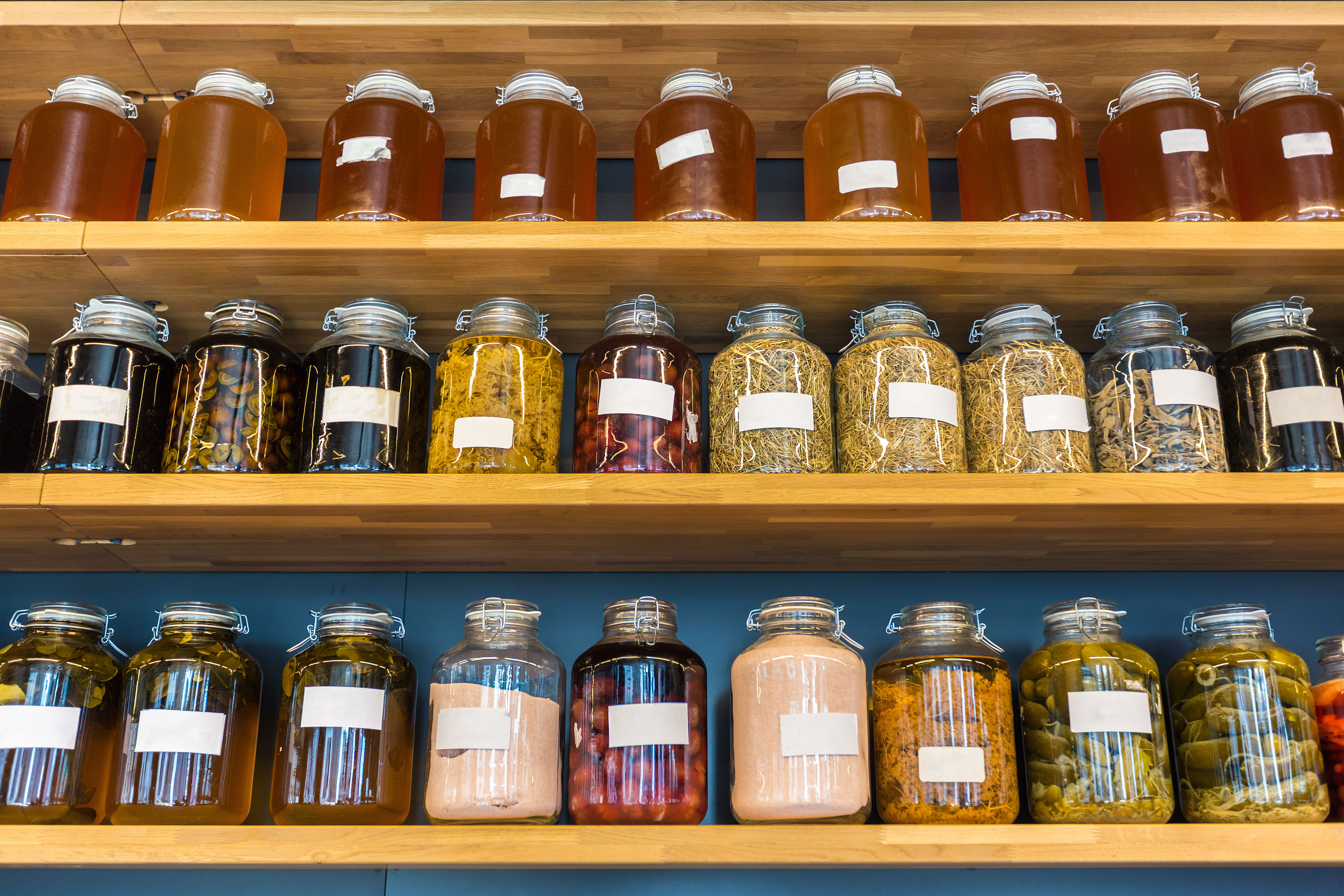
Transparent jars reveal quantity, reduce packaging noise, and can make frequently used staples easier to handle. They also require buying the right capacity, transferring contents, preserving essential information, cleaning vessels, managing partial refills, and deciding what happens when the new package exceeds the remaining space.
A successful jar holds a stable category bought in a predictable quantity and used often enough to justify the transfer. Its opening suits the scoop or pour. Its lid is easy for the household to operate. Its shape uses shelf depth well. The product’s identity, instructions, allergen information, or dates remain available where needed.
Not everything must decant. Awkward snacks, changing brands, tiny quantities, and products whose packages work perfectly may belong in a basket or drawer. The pantry does not become less sophisticated because one bag has declined the uniform.
Container capacity
The jar must hold the new bag before the old bag becomes a countertop tenant.
Many beautiful pantry systems fail at refill. A container looks generous when half empty, then a standard grocery package arrives and does not fit. The remaining portion stays clipped beside the jar, creating two inventory records and one small domestic grievance.
Choose container volume from real purchase sizes and refill habits. If the household replenishes before the jar is empty, capacity must accommodate overlap. If bulk buying changes seasonally, the pantry may need a separate reserve zone. If two similar ingredients must never be confused, appearance alone is not enough; labels and placement carry that burden.
The right container fits the package, the shelf, the hand, the scoop, the cleaning method and the refill cycle. Photographs have no opinion about any of those. Design intelligence is occasionally less glamorous than matching lids. It remains considerably more useful.
Baskets
Woven storage is where irregular packaging goes to regain its dignity.
The baskets soften the white architecture, conceal visual noise, and handle categories that do not cooperate with glass: packets, refills, linens, paper goods, small tools, or backstock. Their texture brings depth to the room without requiring pattern on the walls.
A basket should be assigned by behavior and labeled where the category is not obvious. It must be light enough to move when full, stable on the shelf, and short enough that contents can be seen or reached. Deep baskets placed overhead can become decorative vaults containing whatever the household no longer remembers owning.
Use fewer, more purposeful baskets rather than a woven monoculture. Some categories need rigid wipeable bins, drawers, trays, or original packaging. Texture contributes atmosphere; the stored object determines suitability.
Visual hierarchy
Not every shelf should demand equal attention.
The image gives the eye a sequence. Large baskets sit high and at the outer edges. Repeated jars occupy the central bands. Wooden boards and bowls create a sculptural working moment near counter height. Larger floor baskets ground the composition. The window provides brightness and release.
This hierarchy matters because open storage can easily become a wall of labels. Group objects into readable fields rather than spacing every item as an individual display piece. Repetition creates calm; variation creates life; negative space tells the eye where one group ends and another begins.
Reserve the most visually active level for the items whose visibility helps daily use. Put quieter forms above and concealed categories below. If every shelf is styled as a miniature still life, the pantry becomes an exhibition hall where dinner ingredients require curatorial approval.
The counter
A pantry needs a place for groceries to land before they acquire permanent addresses.
The counters in the photograph are unusually restrained, which allows the room to function as more than storage. A landing surface supports unpacking, decanting, weighing, organizing, setting down a basket, staging ingredients, or handling the package that leaked in the car because it had ambitions.
Protect at least one continuous section of counter from permanent storage. Decorative vessels, spare jars, serving boards, and appliances can consume the landing zone slowly because each object seems reasonable alone. Mark the space by function: groceries arrive; baking ingredients gather; containers refill.
A counter is valuable because it absorbs transition. Without it, every task happens on the floor, against a shelf edge, or back in the kitchen. The pantry then stores beautifully while exporting all of its work elsewhere.
The grocery-arrival sequence
Design the ten minutes after the bags hit the house.
Groceries enter carrying packaging, receipts, temperature-sensitive items, replacements, duplicates, and decisions. The pantry should support a clear sequence: land bags, remove items destined elsewhere, scan existing quantities, place immediate-use goods, refill only where useful, store reserve stock, flatten or discard packaging, and restore the counter.
If refilling every jar is required before food can be put away, the system may be too ceremonial. Some households enjoy that ritual; others need a basket labeled backstock and a refill schedule that does not turn a weeknight into retail operations.
The best pantry meets the household at its actual energy level. A system designed for the most motivated version of its owner will fail on the first wet, late, hungry grocery night. Build for ordinary competence, then allow occasional magnificence.
Inventory intelligence
A pantry should answer three questions without an archaeological dig.
What do we have? What is running low? What should be used next? Transparent containers help with the first two. Grouping, dates, front-to-back rotation, and a specific near-term zone help with the third. Visibility alone does not create inventory intelligence if similar foods scatter across the room.
Give each category one primary home and one legitimate reserve location. Avoid storing the same item in several unconnected baskets. Keep frequently checked quantities in the easiest scan line. Place open packages where they remain obvious rather than allowing five nearly finished bags to conduct separate careers.
A short weekly scan can prevent overbuying without requiring an app, spreadsheet, or barcode empire. The pantry should make the truth easy to see. Technology may assist; it should not be needed to locate the oats.
Light and food
The window makes the room glorious. It also makes observation necessary.
Daylight enlarges the pantry, reveals the warm textures, and reduces the enclosed feeling common to storage rooms. It also introduces changing sun, heat, glare, and exposure. The photograph cannot tell us how direct or sustained that light is, so it cannot prove that every visible food belongs beside the window.
Use the actual room across seasons. Note direct sun, temperature changes, moisture, ventilation, and which shelves remain stable. Place decorative or less sensitive objects where light is strongest if food quality would be compromised. Curtains, shades, UV control, or relocating categories may be appropriate depending on the site.
The window should remain accessible for cleaning and operation. A beautiful sill packed with jars can block the very light and maintenance access that make it useful. Daylight is an asset, not an excuse to warm the backstock for dramatic effect.
Height and reach
The top shelf is not storage if it requires a household expedition.
High shelves can hold light, infrequent, or decorative objects. They should not become the default home for heavy containers used weekly. The large baskets above the central shelves look balanced in the image; a real household must decide whether their contents, weight, and removal method make that location credible.
Design around the people who use the pantry. Record comfortable reach, vision, grip, lifting, bending, and the ability to carry items while moving through the room. Frequently used goods belong within easy reach. Heavy items generally benefit from lower, stable positions. A step stool needs its own safe, accessible home if it is part of the plan.
Accessibility improves the pantry for everyone. Clear labels, contrast, predictable categories, shallow shelves, easy hardware, open landing space, and reduced lifting make everyday use faster. They also rescue the room from the fiction that every resident is the same height and permanently available for overhead basket retrieval.
The floor baskets
Low storage must not steal the turn, the toes, or the cleaning route.
The tall woven baskets ground the back wall and use space below the counter. They could hold many categories, but the image does not identify them. Their design value is clear: large-volume concealed storage without adding another bank of cabinetry.
Their operational value depends on weight, frequency, and clearance. A basket that must be dragged into the only standing zone may complicate use. Loose fibers, deep interiors, and contents near the floor affect cleaning and retrieval. If the basket holds something heavy, handles and movement matter more than its lovely vertical proportion.
Keep the main route legible and preserve access to corners, baseboards, and lower shelves. Floor storage should occupy a defined bay, not spread because the pantry has run out of decisions.
Backstock
Reserve inventory needs boundaries before optimism starts buying twelve of everything.
Bulk and reserve goods can save trips or money, but they consume predictable volume. The pantry should assign a maximum backstock zone by category. When that zone is full, the answer is not another basket placed on the counter. The answer is that the household has reached its chosen capacity.
Store reserve items near their active category where possible, while keeping the open container easy to identify. Use the oldest suitable item first. Avoid creating a beautiful front row that hides a less photogenic backlog behind it.
Capacity is a design decision, not a challenge issued to the shelving. The pantry should support the household’s actual shopping pattern, emergency preference, budget, and storage conditions without becoming a private warehouse that occasionally loses cumin.
Maintenance intelligence
Every visible object joins the cleaning plan.
Open shelves collect dust and kitchen residue. Glass shows fingerprints and crumbs. Woven fibers trap small debris differently from smooth bins. White surfaces reveal spills. None of this makes the room impractical; it makes maintenance part of the design rather than an unpleasant sequel.
Choose finishes and containers that the household can realistically clean. Preserve enough space to remove jars without dismantling the shelf. Avoid crowding the counter edge. Keep a small, convenient cleaning kit nearby if that shortens the reset, but do not store chemicals carelessly among food.
The maintenance burden should be proportional to the value visibility provides. If the household resents wiping forty jars, reduce the number of visible jars. The pantry is allowed to prefer sanity over a full audition for the role of organized person.
The refill ritual
A system succeeds when it knows what happens to the final handful.
When a jar runs low, the pantry needs one clear response. Refill from a known reserve, add the item to a list, move the remainder to a near-term-use zone, or return the original package to its assigned basket. Ambiguity creates duplicate purchases and half-empty vessels.
Labels should identify contents where appearance is not unmistakable and preserve any information the household needs. Refill containers should be cleaned on a sensible cycle rather than endlessly topped up without attention. The exact process depends on the food and household; the essential design point is that the process exists.
A refill ritual is simply the closing movement of visible storage. The jar has made inventory legible; the household must decide what it does with that information.
Failure study
How the dream pantry becomes a very photogenic burden.
Failure one: container-first planning. Matching jars are purchased before the inventory is measured. They fit the shelf and fail the groceries.
Failure two: everything is displayed. Open packaging, appliances, serving ware, bulk stock, linens, and snacks compete across every level. Visibility stops helping and begins broadcasting.
Failure three: baskets become amnesia. Categories are too broad, labels are absent, and deep containers hide old stock beneath new purchases.
Failure four: no landing zone survives. The counter becomes permanent storage, so unpacking and refilling migrate back to the kitchen.
Failure five: the pantry is designed for one photograph. There is no room for a changed diet, larger package, holiday ingredients, a household member with different reach, or the week when nobody has time to decant anything.
Three versions
The room can be smaller. The logic cannot.
The cabinet pantry: use pull-outs, drawers, a few transparent containers, and one concealed bin for irregular packaging. Preserve visibility through labels, shallow zones, and grouped categories rather than open shelves.
The converted closet: add shallow adjustable shelving, good light, a protected landing shelf if possible, door-mounted storage only where clearance allows, and a disciplined limit on bulk stock. The door itself provides visual calm.
The walk-in pantry: organize the complete room by vertical reach, shelf depth, grocery arrival, reserve capacity, counter work, light, cleaning, and movement. More space does not remove the need for boundaries; it merely gives unmade decisions larger accommodations.
Across all three, preserve the same intelligence: one home per category, visible quantities where helpful, concealed irregularity, measured container capacity, a landing zone, accessible reach, and a reset that can occur without a personality transplant.
Material and color
White provides the silence. Fiber and timber provide the appetite.
The palette is restrained: chalky white, clear glass, oat-colored weave, honey and walnut timber, muted ingredient tones, a small amount of herb green, and dark floorboards. The dark floor keeps the room grounded; without it, the pale architecture and baskets could drift into one continuous cloud of tasteful organization.
An interpretive palette: chalk #F2EFE7; warm white #DDD7CA; oat #C5AA80; honey timber #A97743; walnut #684628; herb #68735A; charcoal #34362F; and dark floor #2B241E. These colors describe the photograph’s design logic rather than measured finishes.
The material story works because texture is concentrated. Architecture stays quiet. Baskets, grain, food, and a few plants carry warmth. If every wall, container, label, and handle also introduced pattern or contrast, the room would lose the composure that makes its abundance feel generous.
Budget intelligence
Spend on the architecture of use before buying the accessories of aspiration.
Prioritize sturdy adjustable shelving, good task lighting, drawers or cabinets where closed storage is needed, a durable landing surface, clear labels, and containers sized to real purchases. These decisions determine whether the pantry works.
Economize by reusing suitable jars, mixing container sizes within a limited family, labeling ordinary bins, and introducing baskets only where they solve visible irregularity. A coordinated pantry can emerge from placement and repetition without replacing every vessel in one dramatic weekend.
If the budget contracts, preserve shelf depth, category homes, lighting, the landing zone, and accessible storage. Delay decorative vessels, elaborate labels, extensive cladding, and the fantasy that every ingredient requires artisanal housing.
The ten-minute reset
The pantry should recover from a grocery trip before the ice cream files a complaint.
Clear the landing surface first. Move temperature-sensitive goods onward. Return daily items to their primary homes. Place reserve stock in its bounded zone. Refill only the containers that benefit from immediate refilling. Capture needed purchases. Remove packaging and wipe any spill.
Scan the open shelves for low stock, duplicates, and items that should move forward. Return baskets squarely enough that labels remain visible. Keep the floor route open. The goal is readiness, not an immaculate performance of domestic virtue.
If the reset routinely takes longer, inspect the causes. Containers may be undersized. Categories may have multiple homes. Backstock may exceed capacity. The landing zone may be too small. The system should absorb groceries, not require groceries to complete an entrance examination.
Definition of done
The pantry is finished when it can be useful without staying camera-ready.
The household can see what it has, identify what is low, and reach what it uses most. Open storage contains categories whose visibility provides value. Irregular packaging and reserve stock have clear concealed homes. Containers fit real purchases. Shelves fit real objects. The counter still functions as a landing and work surface.
The room tolerates a partly empty jar, a changed brand, an unstyled grocery night, and another person’s method of use. High and low storage respect bodies. Light supports reading and work without creating unexamined exposure. Cleaning is possible without dismantling the composition.
Most importantly, the pantry feeds the household more effectively than it feeds the image. It can be beautiful, tactile, calm, and deeply satisfying. It simply cannot require everyone who enters to become an unpaid prop stylist.
Final direction
Make the pantry legible, generous, and a little less impressed with itself.
Use visibility where it helps action. Use concealment where it reduces noise. Measure the packages. Protect the counter. Bound the backstock. Give the grocery bags somewhere to land and every category one convincing address.
Then add the beauty: woven texture, timber grain, repeated glass, calm architecture, daylight, and enough negative space for the room to breathe. Beauty should emerge from the storage logic, not sit on top of it holding a label maker.
A pantry is a room in constant exchange—full, low, replenished, used, spilled, cleaned, changed. Design for that movement, and the calm becomes something better than staged. It becomes durable.
Storage that earns its volume: Objects That Change the Room and Space Intelligence. A working pantry instead of a still life is also a Rooms in Real Life question—can it recover after restocking day?
Same problem, elsewhere in the house
Room notes
Keep the room on the record.
One useful note at a time: what to test, what to ignore, and what changed when the room got another vote.