Outdoor Rooms
Treat the Balcony Like a Room, Not a Storage Ledge
A small balcony accumulates leftovers instead of supporting one deliberate activity.

On this page
47
A balcony becomes a storage ledge by degrees. One folding chair arrives. Then a bag of potting soil, three empty planters, a drying rack, the cushion that should have gone into storage, and a small table nobody can reach without first moving everything else.
Nothing on the balcony is necessarily wrong. The problem is that every object has been allowed to make a separate claim on a very small piece of architecture. The space is asked to be garden, dining room, utility zone, emergency storage, laundry annex, and atmospheric view all at once. It responds by becoming none of them convincingly.
A balcony becomes a room when it receives one deliberate life, a protected route, a useful threshold, a reason to stay, and an operating routine that does not collapse the moment weather or ordinary household behavior enters the scene.
Balcony premise
Do not begin by asking what furniture fits. Begin by deciding what life deserves the balcony’s best light, deepest view, clearest route, and most comfortable position.
A balcony is its own kind of room
A balcony is not merely a very small patio
A patio usually has some relationship to ground, garden, and multiple approach directions. A balcony is suspended territory. Its conditions are sharper: the door is often the only entrance, the railing defines the view, wind may arrive without warning, drainage is visible and consequential, storage is limited, and every inch of furniture affects movement.
That difference matters. Advice designed for a broad terrace can make a balcony feel smaller, heavier, and more exposed. A conventional outdoor sofa may consume the threshold. A continuous wall of planters may erase the horizon. A dining table that technically fits may require chairs to occupy the only route when used.
The balcony should be read as a complete spatial type with its own advantages:
- distance from the street or garden can create privacy and a sense of retreat
- height can provide sky, moving weather, rooftops, trees, and borrowed views
- a compact footprint can become intimate quickly
- the doorway can create a strong relationship between interior and exterior rooms
- a limited number of objects can establish a convincing identity
- seasonal changes can be made without redesigning an entire yard
Its smallness is not the defect. Indecision is usually the more expensive problem.
Choose one primary life and let everything else negotiate
The balcony cannot be designed around the phrase outdoor living. That phrase contains too many lives and no useful floor plan. Name the activity that should happen often enough to deserve permanent territory.
The morning balcony
This version needs an easy route from the kitchen or bedroom, a dry and comfortable seat, a reachable surface, useful early light, and enough shelter that a cup can be set down without conducting a wind experiment.
The reading balcony
This version needs a chair that supports a real reading posture, light that reaches the page, a place for a book and drink, relief from glare, and a degree of enclosure that allows concentration without eliminating the sky.
The two-person conversation room
This version needs seats with a believable relationship, somewhere for each person to place a drink, enough room to enter and sit without choreography, and light that supports faces after dark.
The planted lookout
This version uses planting to frame the view, create privacy, or mark the threshold while preserving a clear standing or seated position. It is a room with plants, not a nursery aisle with a railing.
The compact dining room
This version needs an honest food route, stable chairs, a table that remains usable after plates arrive, and enough operating space that the person nearest the door is not appointed gatekeeper for the entire meal.
The short-weather retreat
This version is designed for ten or twenty deliberate minutes: a protected perch, low light, a view of rain or snow, and materials that can tolerate a room used in brief but memorable intervals.
Secondary uses can still appear. A reading balcony may host a drink with a second stool. A morning balcony may use a folding surface for an occasional meal. The distinction is that temporary uses arrive without permanently occupying the best territory.
Protect the threshold before placing the first chair
The door is not a leftover edge. It is the balcony’s primary piece of architecture. It controls arrival, escape, carrying, ventilation, weather, storage, and the visual relationship between rooms.
Mark the full door swing, including any screen or secondary door. Then mark the standing area needed to open, close, lock, and pass through while carrying the objects that actually travel outside: a drink, watering can, blanket, tray, laptop, laundry basket, pet lead, or cushion.
A balcony can look spacious while empty and become unusable when the door, chair, and body operate at the same time. Test the moving room, not the empty rectangle.
Door envelope
The area required for every door panel, handle, latch, and body movement to operate without collision.
Arrival landing
A clear place to step, pause, turn, and understand where the primary activity begins.
Carrying route
The path used while hands are occupied. It should not depend on moving planters, folding chairs, or decorative objects.
Return route
The path back indoors after dark, during weather, or while carrying used dishes, wet objects, or maintenance supplies.
If furniture must move every time the door opens fully, the arrangement is unfinished.
Give it a horizon, and the right kind of privacy
Give the balcony a horizon
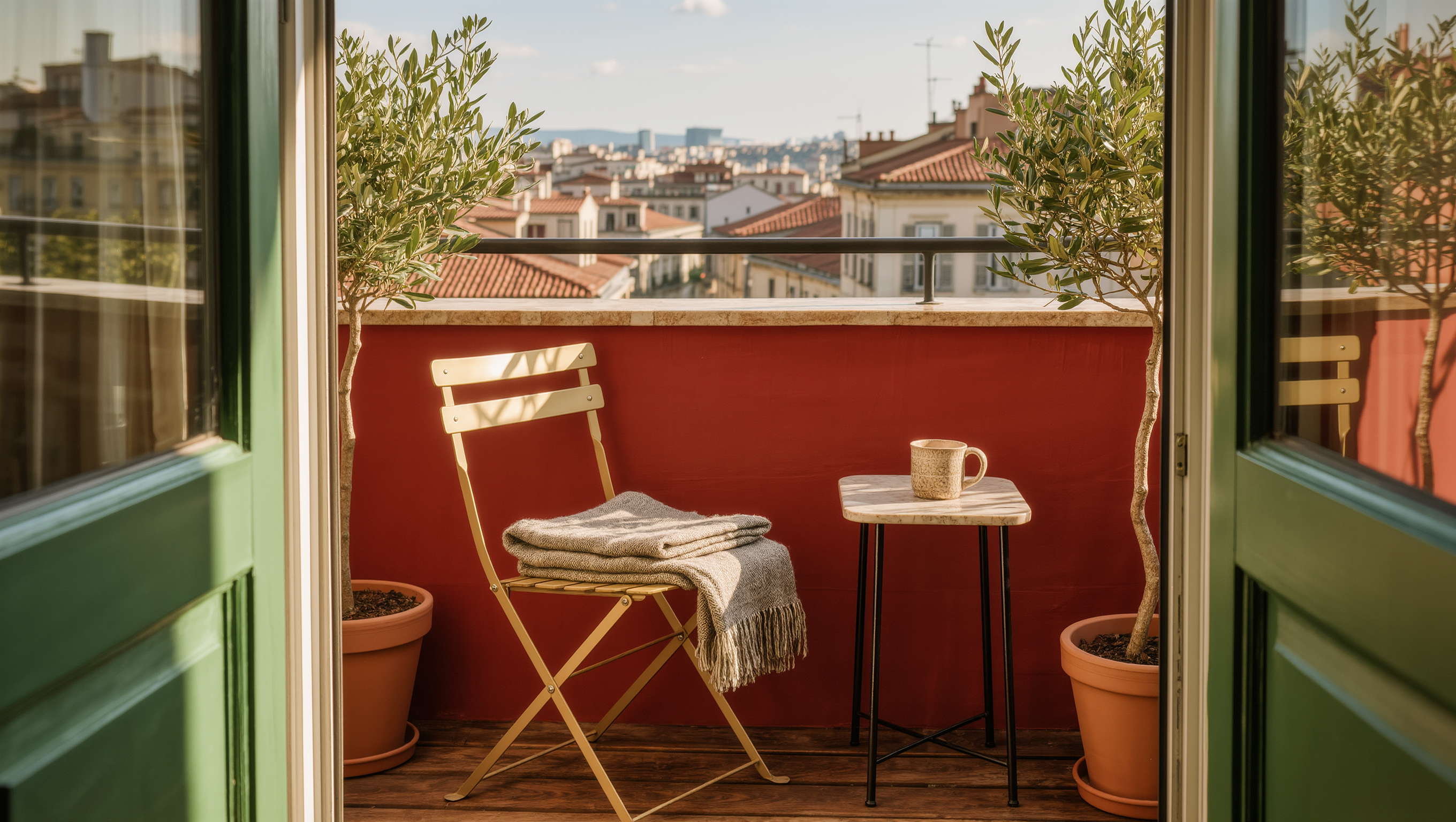
A balcony arrives with one problem a patio does not have, and it is the railing. It sits at roughly the height that halves a seated view, and most balconies then stack a screen, a row of planters and a set of railing hooks on top of it and the eye then travels about as far as the nearest chair back before giving up.
Choose one outward sightline and protect it. A tree, a patch of sky, a distant roofline, a long street perspective, neighboring architecture, the weather, the sunset, or simply the deepest diagonal across the floor. Then keep the foreground below it: low furniture and low planting near the view, height moved to the sides where it frames rather than blocks, the largest chair back out of the doorway line, one quieter edge instead of a filled perimeter, and a farther surface or plant lit after dark so the horizon survives sunset. Check all of it from seated eye level, which is where you will actually be.
Depth on a balcony is a matter of direction and restraint: one way for the eye to travel, and enough left alone around it that distance can take part. The view itself can be entirely ordinary.
Privacy should solve an exact sightline
Exposure on a balcony can feel intense because neighboring windows, adjacent balconies, streets, and taller buildings may reach the occupied position directly. The instinct is often to screen the whole perimeter. That can remove air, light, sky, and the very distance that made the balcony appealing.
Sit in the actual chair. Stand at the threshold. Identify the precise view that creates discomfort. Mark its width and height. Then test the smallest intervention that changes the experience.
Low seated screen
Useful when privacy is needed only below railing or seated eye level while the upper view remains valuable.
Tall narrow screen
Useful for one neighboring window, street angle, service view, or exposed corner without enclosing the entire balcony.
Layered planting
Useful when a softer, changing boundary suits the site and maintenance routine. Leave gaps for air, light, and visual depth.
Changed orientation
Sometimes rotating the primary seat removes the direct sightline more effectively than adding material to the perimeter.
Any attachment, screen, planter, shade element, or overhead object must suit the building, exposure, lease or property rules, and applicable requirements. The design principle remains simple: solve the real view, not an abstract fear of being seen from every direction.
Read the balcony’s microclimate at body level
A balcony can be sunny and cold, shaded and hot, sheltered at the floor and turbulent at shoulder height. Conditions change with building orientation, height, adjacent walls, glass, railings, overhangs, and reflected heat.
Observe the balcony during the hours it is intended to work. Sit where the chair will sit. Record what reaches the face, hands, legs, table surface, and door.
Sun and reflected heat
Direct sun may be only part of the problem. Glass, pale walls, metal railings, masonry, and neighboring surfaces can reflect heat or glare into the occupied position. Shade should protect the body and activity, not merely cast a pleasing shape across the floor. The glass balustrade that looked so crisp in the listing photograph can turn into a very efficient grill by mid-afternoon, and the chair is the thing being grilled.
Wind
Notice direction, gusts, uplift, and what the wind actually disturbs. A lightweight stool, umbrella, textile, tall empty planter, or loose cover may behave differently at balcony height than it would at ground level. A partial protected back may improve comfort without trying to stop every breeze. An empty lightweight planter several floors up is a sail waiting for its moment, and the moment usually arrives at night while everyone is asleep.
Rain and drainage
Track where water enters, where it collects, and how quickly surfaces dry. Furniture, rugs, planters, and storage must not block drainage or direct water toward the threshold. The room should remain recoverable after weather without requiring every object to be carried indoors.
Sound
Street noise, mechanical equipment, neighboring conversations, and reflected sound can shape use. Soft planting, textiles, changed orientation, and choosing a quieter time of day may help. No balcony gets acoustically sealed. The decision available is which activity can coexist with the sound that is actually present.
Furniture, planting, and storage
Choose furniture by posture, reach, and reset
Balcony furniture is often selected because it is described as compact. Compact is not the same as comfortable, stable, movable, or useful.
Begin with the body. A chair for coffee may support a more upright posture than a chair for reading. A dining chair needs a different relationship to table height than a lounge chair. A bench can preserve visual continuity and seat more than one person, but may offer poor back support or become difficult to move and dry.
Then study reach. Every regular seat needs a plausible place for a drink, book, plate, device, or gardening tool. The surface should be reachable without leaning into the route or standing up. One oversized central table can occupy more floor while serving fewer people than two small movable surfaces.
Finally, test reset:
- Can the chair remain outside in ordinary conditions?
- Does it need a cushion, and where does that cushion live?
- Can one person move it for cleaning or weather?
- Does it become dangerously hot, wet, unstable, or slippery?
- Can the floor and railing be accessed around it?
- Where does a folded or moved piece park without blocking the door?
- Does the piece still fit when occupied rather than neatly tucked away?
A piece that fits only while nobody is using it does not fit.
Planting should build the room, not consume it
Plants can create threshold, shade, privacy, rhythm, scent, movement, and a stronger relationship to the view. They can also take over the route, hold water against surfaces, drop material onto seating, become unstable in wind, and create a care system larger than the room itself.
Choose the spatial job first:
Frame the view
Place height at one or both sides while leaving the central horizon open.
Protect one exposed edge
Use a concentrated group rather than a continuous line around the perimeter.
Mark the threshold
One substantial specimen or paired forms can show a visitor where the entrance is without narrowing the door.
Create a seasonal focal point
Use one composition that can change through the year while the room’s permanent structure remains clear.
Plan for mature width, height, weight, drainage, watering, wind, falling material, and seasonal movement. A few substantial forms usually create more architecture than many small pots distributed across every available edge.
Keep the maintenance route visible. If watering requires moving the chair, lifting containers over the threshold, or letting runoff cross the primary route, the plant scheme has not finished negotiating with the room.
Storage must earn balcony territory
A balcony often becomes storage because it is technically outside the interior floor plan. That does not mean it is functionally free.
Storage should be limited to objects that directly support the balcony’s primary life or genuinely need to live near that threshold. Cushions, a watering can, a compact blanket, or a small set of tools may qualify. Unrelated household overflow does not become outdoor equipment because it has been placed beside a planter.
Evaluate any storage piece as furniture:
- Can it tolerate exposure and drainage conditions?
- Can it open fully without blocking the door or chair?
- Will contents remain dry, ventilated, and accessible?
- Does it create a useful seat or surface without compromising comfort?
- Can the floor beneath and behind it be inspected and cleaned?
- Does its visual mass close the horizon?
The most useful balcony storage may be just inside the door. Proximity can support the routine without spending exterior space on a weatherproof box full of damp uncertainty.
From inside, after dark, through the year
Design the balcony from inside as well as outside
The balcony may be seen from the interior for far more hours than it is occupied. That view should not force the room into permanent staging, but it should remain coherent when empty.
Stand at the main interior sightline. Notice whether the first thing visible is the back of a chair, a storage lid, a cover, a collection of small pots, or a strong invitation outward. A clear floor line, one substantial plant, a well-placed chair, or a softly lit edge can make the balcony read as a destination.
Then sit outside and look back in. Bright interior light, a cluttered threshold, television glow, or the practical contents of the adjacent room may dominate the view. The balcony may need a slight change in orientation, lower interior light after dark, or a stronger exterior focal point.
The two rooms have to acknowledge one another. Whether they match is a taste question and a much smaller one.
Finish the balcony after sunset
A balcony used in the evening requires more than decorative glow. The threshold, primary activity, faces, surfaces, and one farther layer must remain readable.
Threshold light
Clarifies the door, floor edge, and arrival without creating glare through the glass.
Activity light
Supports reading, food, drinks, plants, or conversation at the position where the activity occurs.
Face light
Allows two people to see expressions without relying on a harsh source above or behind them.
Depth light
Reveals one plant, wall, railing layer, or distant element so the balcony does not collapse into a bright patch beside the door.
Use the lowest effective amount of light, shield sources from direct view, and consider neighbors and interior reflections. Portable, rechargeable sources can be useful for testing position before any permanent decision. They still need a stable home, a charging routine, and products appropriate to the intended conditions.
Give the balcony more than one seasonal state
The same arrangement does not need to remain fully furnished through every season. A good balcony can change its operating mode without losing its identity.
The first mild day
Bring out only what the primary activity needs. Check drainage, surfaces, plant condition, attachments and wind before rebuilding the entire summer inventory — the attachments in particular, because the thing most likely to have moved over winter is the thing that was fixed to the railing.
High summer
Shade, heat, watering, insects and evening use take over. The balcony often works best at a different hour than expected, and with a more open floor than anybody plans for.
Pulling in
Reduce the arrangement to a tighter, more protected center. Add a portable textile and lower the light, and take away the pieces that have stopped supporting frequent use. Autumn is when a balcony either contracts deliberately or simply stops getting used, and the household rarely notices which one happened.
Winter composition
The room may become a short coffee perch, lantern room, lookout, or primarily a view from indoors. Evergreen structure, bare branches, one durable chair, and a clear floor can carry the identity without pretending winter is delayed summer.
Respect rental, building, and attachment limits
Balconies belong to larger structures and shared conditions. Before attaching screens, shades, lighting, planters, hooks, flooring, or heavy objects, confirm what the building and property permit and what the specific structure and exposure can support.
This does not make renter-safe or reversible design visually timid. Freestanding screens, weighted but movable planters, tension-based solutions where appropriate, portable lighting, outdoor textiles, and carefully scaled furniture can create a complete room without pretending the balcony is a private construction site.
The design should become more exact when permanent alteration is limited, not more miscellaneous.
Strip it back and see what you miss
Empty it, then put things back one at a time
01
Remove unrelated storage
Clear the threshold, floor, railing line, and best view. Store only what is required for the test.
02
Name one primary activity
Choose the activity and the hour it should work. Write down what the body and routine require.
03
Mark the operating envelope
Test the door, route, occupied chair, table reach, and any moving or folding pieces at full use.
04
Protect one horizon and one privacy problem
Keep the best outward line open. Test a temporary screen or planting mass only where exposure is actually felt.
05
Use the balcony in ordinary conditions
Use it on several days, including the mediocre ones. Record when you leave, fetch something, move a piece, or decide setup is not worth it.
06
Test after dark
Add one portable source at a time. Check the threshold, activity, faces, depth, neighbors, and reflection in the door.
07
Time the reset
Return the room to its ready state. Anything repeatedly left in the doorway, carried through several rooms, or moved without a destination needs a better plan.
Common ways a balcony loses its life
- Every possible activity receives a permanent object.
- The door opens only when furniture is folded or moved.
- Privacy planting becomes a continuous wall and removes the horizon.
- The best seat is arranged for the view from indoors rather than the experience outside.
- Furniture is compact but uncomfortable enough that nobody stays.
- Every soft object requires a storage ritual before use.
- The balcony works in daylight and becomes a dark threshold after sunset.
- Small pots and accessories occupy every edge without creating structure.
- Storage expands until the primary activity becomes occasional.
- The room is photographed in perfect weather and operated in none of it.
Continue outside
Let the small room become specific
Two chairs, one protected view, and nothing anybody has to move before sitting down. Most balconies are instead doing unpaid work as a shelf for the objects that did not fit indoors, and the door stays shut all summer.
Same problem, elsewhere in the house
Room notes
Keep the room on the record.
One useful note at a time: what to test, what to ignore, and what changed when the room got another vote.