Furniture and Scale
Outdoor Furniture That Cannot Survive Your Routine
Outdoor furniture is selected for the photograph rather than exposure, storage, cleaning, and actual use.

On this page
48
Outdoor furniture can survive rain, sun, frost, wind, pollen, and several years of manufacturer testing—and still lose the household by the second weekend.
The problem often has nothing to do with a broken frame. The cushions remain inside because carrying them out is annoying. The cover fills with water. The chair is too hot at the hour anyone wants to sit. The table cannot move for cleaning. The umbrella requires a negotiation with the forecast. A storage box appears to solve everything and becomes a large damp archive of objects nobody wishes to identify.
Outdoor furniture has two climates to survive: the weather and the routine. The second is usually described less accurately.
Furniture premise
Do not buy for the most flattering hour of the most ambitious day. Choose pieces for the body, exposure, setup, cleaning, storage, movement, and frequency of the life that will actually happen outside.
The furniture fails long before it breaks
A piece is spent when the work of using it costs more than the thing you wanted to do out there. Nothing has to break for that to happen. The frame can still be under warranty.
- The cushions stay indoors on a perfectly mild evening because setting up feels out of proportion to twenty minutes outside.
- One person cannot move a piece on their own, so it is never moved for cleaning, for weather, or for a different activity.
- The seats look generous and deliver poor posture, poor reach, or a frame that is too hot to touch at the hour anyone wants it.
- The room has claimed an indoor storage territory bigger than its frequency of use can justify.
- Materials are aging in a way the household reads as damage rather than as character.
- Cleaning keeps getting postponed, because getting underneath and around the furniture is a job in itself.
Read that as an attendance record rather than as a snag list. Every line on it is a reason somebody stopped going outside, and in most of those cases the furniture was in perfect condition the entire time.
Define the activity before evaluating the furniture
Furniture categories are broad. The body’s requirements are specific. A chair for ten-minute coffee, a chair for a full meal, a chair for reading, and a chair for a long evening conversation are not interchangeable because they all contain a seat and back.
Morning coffee
Quick access, a dry seat, upright comfort, a surface within reach, and almost nothing to set up. A large lounge arrangement adds work to a ten-minute ritual and improves none of it.
Outdoor dining
Stable chairs on whatever the floor actually is, a table at a height that suits them, room to push back, a serving route, and surfaces you can wipe. The comfort has to last the length of the meal.
Reading and retreat
Real back and arm support, relief from glare, somewhere for feet if you want them up, task light after dusk, and a table you can reach without sitting up out of the chair.
Flexible hosting
Several postures, seats one person can move, companion surfaces that stay put, and circulation that survives the extra chairs. Pieces that join the room for an evening have to be able to leave it again without turning into a storage problem.
Garden or making work
Working height, water and tools nearby, surfaces that clean, and permission to look used. Decorative softness here is just one more thing to move.
Short seasonal use
A compact arrangement that opens, closes or changes without an annual furniture migration.
If the space has one dominant activity, buy for that activity. Occasional uses can borrow, fold, move, or appear temporarily. Permanent furniture should not be selected for the rarest version of the household’s life.
Count the actions before you count the pieces
Every object out there arrives with a set of actions attached to it. Somebody uncovers, unlocks, carries, unfolds, wipes, dries, arranges, fills, charges or secures it before anyone sits down, and then runs the whole sequence backwards afterward.
Write it out for an ordinary day rather than a good one:
- open the door or storage
- remove and park covers
- carry cushions or textiles
- wipe pollen, dust, or standing water
- move furniture into operating position
- open or secure shade
- retrieve lights, serving pieces, tools, or blankets
- use the room
- clear food, glasses, or materials
- dry or clean surfaces
- return cushions, covers, shade, and movable pieces
- secure objects for wind or overnight conditions
The total is the room’s setup burden. A beautiful arrangement that requires twelve actions for twenty minutes of use will be admired from indoors.
Maintenance is one of the design’s recurring activities.
Exposure, and how materials actually behave
Map exposure by position, not by postal code
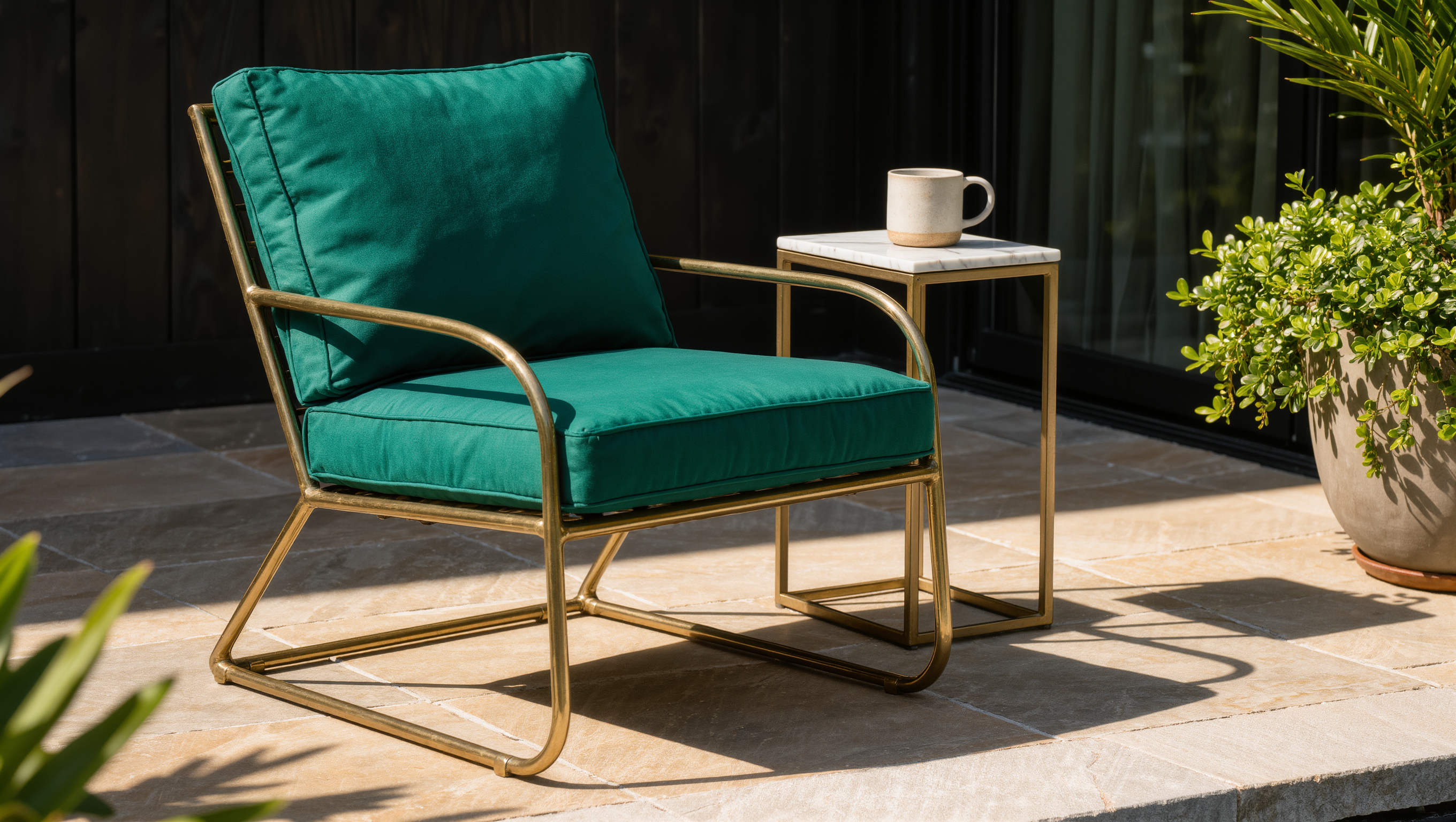
Outdoor-rated is a category, not a forecast. Exposure changes across a few feet — one end of a balcony can be shaded all afternoon while the other end cooks, and a chair does not get to average them.
Watch where each proposed piece is actually going to live:
- direct sun and duration
- reflected heat from glass, walls, paving, or railings
- prevailing wind, gusts, and uplift
- rain direction, roof runoff, irrigation, or splashing
- standing water and drainage speed
- snow, freeze-thaw conditions, salt, or coastal exposure where relevant
- tree debris, sap, fruit, pollen, birds, and insects
- shade that slows drying
- contact with soil, grass, gravel, or porous surfaces
- storage conditions during the off-season
Then take that list to the exact product and check it against the manufacturer guidance, care instructions, warranty limitations, fastening requirements, cushion construction, and storage recommendations. A broad material label is not proof of suitability. The warranty language is usually where the real operating conditions are written down, in the part nobody reads until something has already gone wrong.
Material behavior is the real aesthetic
Outdoor materials get sold on finish and color. What decides whether you still like them in five years is heat, moisture, movement, wear, cleaning and age — none of which is visible in the photograph you bought from.
Metal
Thin profiles, real strength, precise lines. Few outdoor materials can stay this slender and still carry weight, which is why metal keeps winning in small spaces. It also conducts heat and cold straight into whoever sits on it, so the same chair can be too hot in the August sun and unsittable on a March morning. Corrosion turns up at damaged finishes and at the fasteners, which is never where anyone is looking.
Check the welds, the joints, the feet, the finish care, whether hollow components drain, and how much a piece has to weigh to stay put on this particular site. Powder coating is not a performance category. It describes a surface, and two chairs wearing the same one can behave completely differently depending on what is underneath. Bare metal also reads hard; it wants a textile or a plant standing next to it before it starts reading as furniture rather than as structure.
Timber
Grain, warmth, and a willingness to age in public. Wood moves with moisture, changes color, and holds dirt in its texture and its joints, which means cleaning, oiling, refinishing, or a decision to let it go silver.
That decision is the whole question, and it gets made by accident far too often. A household that wants teak to stay honey-colored has taken on an annual job. A household that likes the gray has taken on nothing. They bought the same bench. Verify the exact wood, the construction, the finish and the recommended placement instead of assuming all timber behaves alike — it does not, and the difference shows up in year three, not year one.
Woven synthetic materials
A good weave is the cheapest route to a chair that is comfortable with nothing on it, which deletes an entire logistics department from the room before it exists. The range of quality inside that one description is enormous: ultraviolet resistance, stiffness, whether a broken strand can be repaired or writes off the chair, and how much dust, leaf litter and water the pattern holds onto.
Inspect the frame under the weave, the tension, the edges, whether a cloth will go into it, and what it feels like against bare skin at four in the afternoon. A weave that photographs well is telling you nothing. The word is a description, not a promise about weather. Given a free choice I take a weave that needs no cushion over a frame that needs four, every time, and spend the difference on the table.
Plastic and composite materials
Light, washable, and capable of shapes nothing else can make. Depending on the formulation they also fade, scratch, go brittle, hold heat, travel in wind, and look temporary — and cheap plastic looks temporary on day one, which is a different problem from failing.
Light furniture that ends up in the neighbor’s yard twice a summer is unfinished, not light, and it needs weight, a tether, or a believable storage plan before it counts as a chair.
Stone, concrete, ceramic, and masonry
Weight, thermal mass, and a kind of stability nothing else offers. They also stain, crack, chip, drink water, get very hot and very cold, and make demands on whatever is holding them up — which matters far more on a balcony or a raised deck than on the ground, and is a question for before the purchase rather than after the delivery.
The trade is worth stating flatly: a heavy table solves the wind permanently and creates a cleaning obstacle permanently. Nobody is ever going to move it to sweep underneath. Confirm the support, the placement, how the finish behaves, what a freeze does to it, and where water goes when it leaves the surface.
Glass
Glass keeps the visual field open and hands back the sky, which is most of its argument. It also displays water, pollen, fingerprints and dust with unusual commitment. Glare, edges visible enough that nobody walks into them, heat, cleaning access and construction all belong in the decision — and so does being honest about pollen season, because that is the month a glass table is either wiped twice a day or quietly abandoned.
Outdoor textiles
Water resistance, drying time, ultraviolet performance, stain behavior, breathability, seams, and what is inside the cushion. The insert decides how long the thing stays wet and almost nobody asks about it. A fabric sold as outdoor may still need drying, covering or storing in the conditions where it will actually live.
Across all seven of these, the useful question is rarely whether the material is good. It is whether the way it ages and the way it has to be cared for match what this household will tolerate and how often anyone is genuinely out there. A superb material in a household that will not maintain it is a slow disappointment with an excellent pedigree.
Comfort, surfaces, and the second system that arrives with them
Comfort has to outlast the sit-down in the shop
Most outdoor furniture gets tested for about the length of a sentence, indoors, in a climate-controlled building, by somebody who is standing up again in a moment. Comfort does not report in until fifteen minutes, forty minutes, a whole meal, or the point in the evening when the temperature drops.
Test, in the position and for the duration you actually mean:
- seat height in relation to standing and table use
- seat depth for the intended posture
- back angle and support
- arm position and width
- pressure at the front edge of the seat
- where feet rest
- whether the body slides forward
- temperature of the frame and fabric
- reach to a table without twisting or leaning
- ease of entering and leaving the chair
A deep low seat photographs as relaxation and quietly excludes anybody who needs firm support or an easy way back up. A rigid upright chair is fine for coffee and punishing by the second course. Any outdoor room expecting more than one kind of person in it needs more than one kind of seat — and the deep-low-everything arrangement is the most bought and least useful outdoor purchase there is, because it looks like the photograph and seats exactly one demographic.
Every seat needs a surface relationship
Furniture plans count seats and tables separately, which is how a yard ends up with six places to sit and one place to put anything down. The question is whether every occupied position can reach a stable surface without standing up.
People need to set down a drink, a plate, a book, glasses, a phone, a tool, medication, a lamp. The central coffee table is usually slightly too low, slightly too far, and already occupied by the room’s decorative life. Several small surfaces beat one large one out here, provided each has a parking position and none of them goes over in a gust.
Test it with your whole body in the chair. Sit back, hold the glass, reach the way you would reach without thinking about it. If that means leaning out of the support, or setting the glass down in the walking route, the surface is standing near the seat without serving it.
Cushions create a second furniture system
Count what a cushioned sofa actually is: a frame, several cushions, covers, inserts, storage volume, drying time, carrying route, cleaning method, and seasonal plan.
Count the cushion actions separately. How many pieces are there? Can one person carry them? Do they have handles? Where do they go during sudden weather? Can the storage accept them without crushing or trapping moisture? Do they return in a specific order? Are loose decorative cushions adding enough comfort to justify their migration?
Consider reducing the number of soft components:
- choose supportive frames that do not rely on many loose pillows
- use fitted seat pads rather than multiple deep cushions where appropriate
- keep one or two portable textiles near the door
- reserve decorative softness for occupied periods rather than permanent staging
- select colors and patterns that tolerate the actual dirt and fading conditions
- provide a drying position, because a storage position alone just puts damp cushions in a box
Fewer soft components does not make the room less generous. It makes it a room somebody can sit down in at four minutes’ notice, which is the only kind that gets used twice in one week.
Covers need a life when they are not covering
A cover protects furniture and arrives with its own maintenance department. Somebody removes it, folds or drapes it, stores it damp or dry, cleans it, secures it, puts it back. A poor fit collects water, traps moisture, abrades the finish it was bought to protect, and becomes a sail the first windy night.
Four questions before you buy one, and the first two decide it:
- Where does it go while the furniture is being used? If the answer is the floor or the railing, it will end up behind the sofa.
- Can it dry fully, and how is it secured?
- Does the furniture in this exact position genuinely need covering at all, or is that a habit inherited from a different yard?
- Would a simpler piece with fewer soft parts remove the need entirely?
A cover thrown behind the sofa is not stored. It is temporarily disguised.
Storage, cleaning, and different bodies
Outdoor storage is not a large damp box
Storage has to separate clean from dirty, dry from wet, daily from seasonal, and soft from sharp. One deep container mixes all four, which is exactly what the big lidded bench does. It is the outdoor equivalent of a drawer everyone is slightly afraid of, and I would rather own three fewer things than own one.
Build storage around categories and access instead. Cushions used most days should not be sitting underneath the tools and the string lights from two Decembers ago. Damp things need ventilation or a drying stage before they go anywhere. Cleaning supplies should come to hand without unloading the room first. And a heavy lid must not open into the route, because a lid that has to be walked around is a lid that stays shut.
Near-door storage
Best for daily visitors: cushions, blanket, lamp, tray, or small tools used almost every time.
Outdoor closed storage
Useful only when the unit suits exposure, drains or ventilates appropriately, opens fully, and does not become the room’s largest visual object.
Seasonal storage
Can be farther away if the move happens only once or twice a year and the route, weight, and available volume are realistic.
No storage
Sometimes the correct answer. Choosing fewer pieces that can remain outside may be more useful than adding furniture to store the furniture.
Cleaning access belongs in the furniture plan
Pollen, leaves, dust, insects, bird debris, food, mud, and water collect beneath, behind, and inside outdoor furniture. The arrangement should permit cleaning without dismantling the room.
Leave enough access to:
- sweep or wash the floor
- inspect and clear drainage
- clean beneath tables and storage
- reach wall, railing, fence, and threshold edges
- remove debris from woven surfaces and joints
- dry pieces after weather
- check feet, fasteners, glides, and contact points
- move the room away from building maintenance when required
Furniture nobody can clean around gets moved less, then cleaned less, then used less, in that order and roughly on that schedule. The decline is never announced. The room simply stops being somewhere anyone suggests going.
Furniture must support different bodies
A room composed entirely of low, deep, soft seating may create one aesthetic and one narrow definition of comfort. Include options with firmer seats, supportive backs, arms, and easier standing height.
Maintain clear routes beside and around occupied furniture. Avoid loose rugs, unstable stools, sharp table edges in narrow paths, and pieces that move unexpectedly when used for support. Provide reachable surfaces and space for mobility equipment or a companion where appropriate.
A collection does not have to match to hold together. Repeated material, color, line or proportion will connect chairs shaped for genuinely different bodies, and a room built that way serves more people than a set ever will. Coherence is a design job. Matching is a shopping shortcut that happens to resemble one.
Let the arrangement change by season without becoming a migration
An outdoor room has several configurations in it. Most households only ever build one and then wonder why it is wrong for eight months of the year.
Open with the minimum viable version — the primary seats, one useful surface, whatever shade or light the season demands — and find out how this particular spring is behaving before every accessory comes back out. Then add only the pieces that support things you do often, and stop at the point where cleaning and reset stay easy enough to run several times a week. That threshold is the room’s real capacity. The seat count is not.
Hosting is a separate state and should stay one. Borrow, unfold or add the occasional seats and surfaces, and decide where they park afterward before the gathering, not during the clearing up. Maximum capacity has a habit of becoming the permanent arrangement by default. That is how a room ends up seating nine and being used by two.
Closing is a sequence, so write it as one that one or two people can genuinely perform: clean, dry, inspect, store. Note the repairs and replacements now, while they are still cheap opinions, rather than meeting them in April as urgent discoveries. And decide deliberately what stays out. A durable table, a bench or one sculptural chair can carry the entire view through winter. Covers, stacked furniture and abandoned accessories should not be the only thing anybody sees from the kitchen window for five months.
Test it before you buy the set
A matching set makes the choosing easy and is sold on exactly that. What nobody mentions is that a set repeats one decision across every piece — so if the scale is wrong, the posture is wrong, the material is wrong or the maintenance is heavy, you have now bought that mistake six times in a coordinated finish.
Test the relationships first, because they are what the set is really selling you:
- chair to body
- chair to table
- table to route
- furniture to door swing
- furniture to shade
- furniture to view
- furniture to storage
- furniture to cleaning access
- furniture to the room’s ordinary number of users
A collected arrangement can be more coherent than a matching set when each piece has a clear job and the material language is controlled. A set is useful only when the relationships are correct.
Use the purchase innocence test
Before buying, keep the proposed object innocent. Do not blame it for solving a problem it has not been asked to prove.
01
Mark the full footprint
Use tape, cardboard, blankets, or existing furniture to represent the piece in operating position. Catalog dimensions describe an object at rest and nothing else.
02
Rehearse the posture
Use a chair of similar height and depth. Remain for the intended duration with the actual activity.
03
Run the route
Open doors and gates, pull chairs back, carry food, move through with another person, and access maintenance points.
04
Perform the reset
Simulate cushions, cover, storage, cleaning, and weather response. Time the complete process.
05
Test the difficult hour
Use the position in direct sun, evening cold, wind, darkness, or whatever condition currently defeats the room.
06
Define success
State what must improve: longer use, fewer setup actions, clear route, better posture, easier cleaning, or reduced storage burden.
If the temporary relationship fails, a more expensive version of the object is not yet the answer.
Run the fourteen-day furniture burden audit
Use the existing arrangement or a simplified temporary version for two ordinary weeks.
Who used it and for how long
When, by whom, for what. Count the unplanned twenty minutes; they tell you more than the dinner you scheduled a week out.
The evenings nobody went out
Every time somebody thought about going outside and did not, with the reason caught immediately rather than reconstructed later: setup, heat, wet cushions, no comfortable seat, nowhere to put a glass, wind, dark, effort. This is the column that diagnoses the room. The rest is supporting evidence.
The step that gets skipped
Carrying, uncovering, wiping, moving, charging, securing, cleaning, storing. One of those is being quietly dropped every single time, and it is the one to fix.
Who does the resetting
Notice who actually does it. When several people use the room and one person puts it back, the arrangement is being held up by that person’s goodwill, and goodwill has a shelf life.
What the weather moved
Whatever shifts, soaks, overheats, pools water or needs rescuing.
The room with nobody in it
Photograph it empty. Look at the covers, the stacked pieces, the stored cushions, the drift of objects that arrived and never left — then ask whether it still looks like somewhere a person could sit down without doing a job first.
At the end of it, take away whichever piece or action generates the most work and live with the room for a few more days. Subtraction costs nothing and is usually the correct first move. Replacement is the expensive way to discover you had a logistics problem rather than a furniture problem.
A buying framework that begins after the test
Once the activity and relationships are proven, compare actual options through the complete operating brief.
Common furniture decisions that create a seasonal side job
- Maximum guest count treated as the daily brief.
- Every seat at the same low depth and the same soft support, so the room offers exactly one posture.
- Assuming outdoor-rated means maintenance-free at this particular exposure.
- Cushions bought before anybody decided who carries, dries and stores them.
- Covers bought with nowhere for the covers to go.
- Light pieces with no wind plan; heavy pieces with no cleaning access. Both end the same way, with furniture nobody moves.
- A large storage box standing in for the decision about what belongs outside.
- Furniture parked over the drainage, or hard against a surface somebody will need to reach.
- Matching the set and never once testing the chair against a body or the table against the route.
- A miserable reset accepted because the arrangement looks complete when it is staged for nobody.
- Replacing the furniture before finding out whether shade, route, light or storage was the actual friction.
Continue outside
Give every object a proven job
The good version is the one where nobody goes outside to check the weather first, or to move a cover, or to fetch the cushions from wherever the cushions live. They just go outside.
Same problem, elsewhere in the house
Room notes
Keep the room on the record.
One useful note at a time: what to test, what to ignore, and what changed when the room got another vote.


